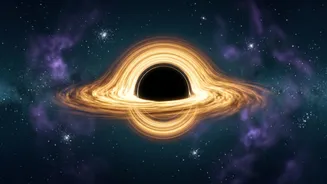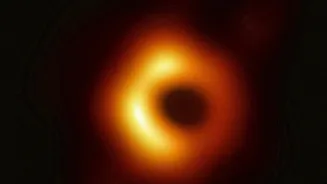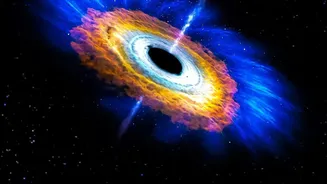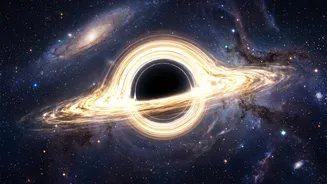




Astronomers believe our galaxy hosts over 100 million black holes, yet we’ve found fewer than 100. The challenge isn't just looking; it's knowing what to look for in noisy data. Enter an unlikely hero: the human eye.
A Cosmic Needle in a Haystack
Finding a black hole is unlike finding
any other object in space. Since they don't emit any light, they can't be observed directly. Astronomers typically spot them indirectly, either through the intense X-rays emitted by matter falling into them or by observing their gravitational pull on a nearby star, causing it to 'wobble'. However, the vast majority of black holes aren't actively 'feeding' and exist quietly. Models predict there are millions of these dormant black holes, many in binary systems with a companion star. The problem is sifting through data from millions of stars to find the subtle clues they leave behind. Automated algorithms are a first step, but they often struggle. They can be fooled by the natural pulsations of a star or by stellar flares, leading to a high number of false positives. The sheer volume of data, combined with its messy, unpredictable nature, creates a bottleneck that pure computation can't easily solve.
The Power of Human Pattern Recognition
This is where the Black Hole Hunters project, hosted on the Zooniverse citizen science platform, comes in. It leverages a tool that remains superior to artificial intelligence in specific tasks: human pattern recognition. The project searches for a phenomenon called 'gravitational self-lensing'. In a binary system, if a black hole passes in front of its companion star from our perspective, its immense gravity bends and magnifies the star's light, causing a brief, symmetrical peak in brightness. While an AI can be trained to look for this signature, it can get confused by other stellar events that cause brightening. Human volunteers, however, are exceptionally good at contextual pattern recognition. They can look at a graph of a star's brightness—called a light curve—and intuitively distinguish a clean, symmetrical lensing event from the noisy, irregular flickering of a variable star. No advanced astronomical knowledge is required. The project simply shows volunteers examples of what to look for, turning a complex data analysis problem into a pattern-matching task.
How to Become a Black Hole Hunter
The process for a volunteer is straightforward. After signing up on the Zooniverse website, they are presented with light curves from telescope surveys. The project initially used data from the ground-based SuperWASP survey but has since shifted to cleaner data from NASA's Transiting Exoplanet Survey Satellite (TESS). An AI first performs a sweep of the TESS data, flagging about one million potential candidates out of 15 million stars to narrow the search. The volunteers then review these candidates. They look at graphs showing a star's brightness over time and classify them, flagging any that show the distinct, short, symmetrical peak characteristic of a self-lensing event. With nearly 23,000 volunteers completing over 12 million classifications, the project has made a massive dent in a task that would have taken a small team of professional astronomers an impossible amount of time.
Forging a New Path for Discovery
The Black Hole Hunters project is more than just a search for cosmic objects; it represents a powerful hybrid model for scientific discovery. The initial classifications made by volunteers are now being used to train more sophisticated machine learning models, creating a feedback loop where human intelligence improves artificial intelligence. This allows researchers to search even larger datasets more efficiently in the future. Even with advanced AI, the project leaders expect that human volunteers will remain a crucial part of the process, working in coordination with the machines to verify potential discoveries. By flagging the most promising candidates, these citizen scientists help astronomers allocate precious time on powerful telescopes for followup observations. Each classification, each flagged light curve, brings the scientific community one step closer to understanding the true population of black holes in our galaxy and the life cycles of the massive stars that create them.