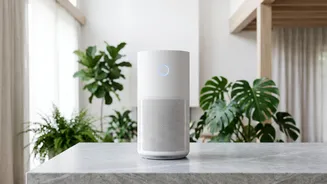









When thick smog blankets the city, we rush indoors for safety. But what if the air inside your home is just as polluted, or even worse? The threat is often invisible, which is where a new generation of technology comes in to make things clear.
The Great Indoors Is a Myth
We think
of our homes as safe havens from the grim, grey haze outside. The reality, however, is that our indoor spaces are not fortresses. Outdoor air pollution, particularly the dangerous fine particulate matter known as PM2.5, easily infiltrates our homes. It seeps through cracks around windows and doors, ventilation systems, and any tiny opening it can find. Studies show that indoor PM2.5 levels can be anywhere from 30% to nearly 100% of the outdoor levels, even with windows closed. But the problem doesn't stop there. Our daily activities generate a host of homegrown pollutants. Fumes from cooking, especially the high-heat tadkas common in Indian kitchens, release a huge amount of particles. The pleasant smell from agarbatti (incense sticks) and dhoop, the chemicals in cleaning sprays, and even the gases released from new furniture and paint (known as VOCs or Volatile Organic Compounds) all contribute to a toxic indoor cocktail. This means that even on a 'good' air day, your indoor environment could be silently harming your health.
Making the Invisible Visible with Smart Monitors
Since you can't see these pollutants, fighting them feels like a losing battle. This is where smart air quality monitors change the game. These compact devices act like a nose for your home, continuously sniffing out and measuring the hidden threats in your air. They use sensors to detect a range of pollutants and display the data in real-time, often on an accompanying smartphone app. This turns abstract danger into concrete numbers you can act on. Key pollutants these monitors track include: PM2.5, which are microscopic particles that can penetrate deep into your lungs and enter your bloodstream. Volatile Organic Compounds (VOCs), which are gases emitted from paints, furniture, cleaning products, and air fresheners. And Carbon Dioxide (CO2), which, while not a pollutant in the same way, is a crucial indicator of how stale your air is and how poor your ventilation is.
What Do the Numbers Actually Mean?
A monitor is only useful if you can understand what it's telling you. For PM2.5, the World Health Organization (WHO) recommends a 24-hour average of no more than 15 micrograms per cubic meter (µg/m³). During smog season in many Indian cities, indoor levels can easily shoot past 80 µg/m³ or higher. Seeing this number spike on your monitor is a clear signal to take action. For VOCs, the goal is to keep levels as low as possible, typically under 250 parts per billion (ppb). A sudden increase might tell you that a new piece of furniture is off-gassing heavily or that you've used too much of a certain cleaning spray. Carbon Dioxide is measured in parts per million (ppm). While outdoor air is around 400 ppm, indoor levels below 800-1,000 ppm are considered good. If you see the CO2 level consistently climbing above 1,000 ppm in a closed bedroom overnight, it's a sign that you're breathing stale, unventilated air, which can lead to headaches, fatigue, and poor concentration.
From Data to Decisive Action
The true power of a smart monitor isn't just knowing the problem; it's being empowered to solve it. When your monitor shows high PM2.5 levels, it’s a clear prompt to turn on your air purifier with its HEPA filter, which is designed to capture these fine particles. It also tells you to ensure all windows and doors are sealed properly to stop more smog from getting in. If you see VOC levels spike after cleaning, you know to ventilate the room by opening a window (if outdoor air is clean) or to switch to low-VOC cleaning products in the future. And if your monitor reveals climbing CO2 levels in a stuffy room, it serves as a reminder to improve ventilation. This could mean briefly opening windows when the outdoor AQI is lower or using an exhaust fan to pull stale air out. By connecting data to action, a monitor allows you to actively manage your environment instead of passively suffering in it, creating a truly clean-air sanctuary for you and your family.