




Why Sitting Causes Stiffness
Our bodies are designed for movement, but modern life often involves long periods of being sedentary. When you sit for hours, your hips are held in a flexed position. This causes the muscles at the front of your hips, known as the hip flexors, to become
short and tight. At the same time, your gluteal muscles at the back of your hips become inactive and weak. This muscular imbalance pulls on your pelvis, reduces circulation, and can lead to the stiffness and discomfort that you feel when you finally stand up. Over time, this can contribute to lower back pain and reduced mobility in daily activities.
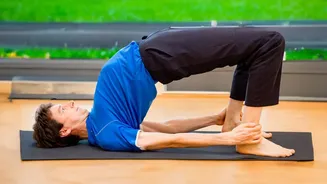
Glute Bridge
This exercise is excellent for 'waking up' the glute muscles that become inactive from sitting. Strengthening them provides better support for your hips and pelvis. To perform a Glute Bridge, lie on your back with your knees bent, feet flat on the floor hip-width apart, and your arms by your sides. Engage your abdominal muscles and glutes, then lift your hips off the floor until your body forms a straight line from your shoulders to your knees. Hold for a few seconds at the top, ensuring you are squeezing your glutes, then slowly lower your hips back down. Aim for 10 to 15 repetitions.
Kneeling Hip Flexor Stretch
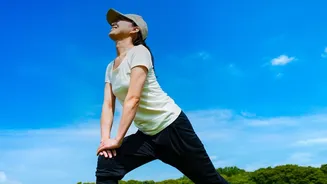
This stretch directly targets the tight hip flexor muscles. Start in a kneeling position on a comfortable surface. Step one foot forward so your front knee is bent at a 90-degree angle and your ankle is directly under your knee. Keeping your back straight, gently tuck your pelvis and shift your weight forward into your front leg until you feel a stretch in the front of the hip of your back leg. Avoid arching your lower back; the movement should come from the hips. Hold the stretch for 30 seconds, then switch to the other side.
Figure-Four Stretch
The Figure-Four stretch targets the deep gluteal muscles, including the piriformis, which can become tight and contribute to hip and even sciatic nerve pain. Lie on your back with both knees bent and feet flat. Cross your right ankle over your left knee, creating a 'figure four' shape. Gently reach through your legs to grab the back of your left thigh and pull it toward your chest until you feel a stretch in your right glute and hip. Keep your head and shoulders relaxed on the floor. Hold for 30 seconds before switching legs.
Butterfly Stretch
This seated stretch helps to open the hips and stretch the inner thigh muscles (adductors). Sit on the floor and bring the soles of your feet together, letting your knees fall out to the sides. Hold onto your ankles or feet and sit up tall, lengthening your spine. To deepen the stretch, you can gently press your knees toward the floor with your elbows or slowly lean forward, keeping your back straight. Hold this position for 30 seconds, focusing on relaxed, deep breaths.
Cat-Cow Stretch
While not just a hip exercise, Cat-Cow is fantastic for promoting mobility through the entire spine and pelvis, which is closely connected to hip function. Start on your hands and knees in a tabletop position, with your wrists under your shoulders and knees under your hips. As you inhale (Cow), drop your belly towards the floor and look up, lifting your tailbone. As you exhale (Cat), round your spine toward the ceiling, tucking your chin to your chest and your tailbone. Continue flowing between these two positions for 10 to 15 repetitions, linking your breath to the movement.