



A Once-in-a-Lifetime Celestial Guest
In the vast, quiet expanse of the night sky, a star that has remained faint for 80 years is about to make a dramatic entrance. Known as T Coronae Borealis (T CrB), or the 'Blaze Star,' this celestial body is a recurrent nova located about 3,000 light-years
from Earth. The last time it lit up our skies was in 1946, a year before India's independence. Now, astronomers predict its next spectacular eruption is imminent, expected anytime between now and September 2024. For a brief period, this cosmic firework will brighten so dramatically that it will be visible to the naked eye, appearing as a 'new' star in the heavens. This isn't just an event for scientists with powerful telescopes; it's a democratic celestial show, open to anyone willing to simply look up.
What Is a Recurrent Nova?
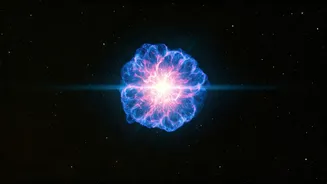
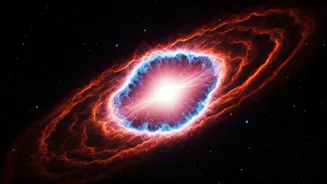
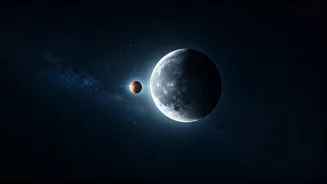
To understand the excitement, we need to know what a recurrent nova is. Unlike a supernova, which marks the violent death of a massive star, a nova is a temporary and non-destructive explosion. T CrB is a binary star system, a cosmic dance between two very different partners: a dense, compact white dwarf and a much larger, aging red giant. The white dwarf’s powerful gravity acts like a cosmic thief, continuously siphoning hydrogen gas from its bloated companion. This stolen material accumulates on the white dwarf's surface, becoming hotter and denser. Eventually, the pressure and temperature reach a critical point, triggering a runaway thermonuclear explosion. This eruption blasts the accumulated material into space, causing the system to flare up thousands of times brighter than normal. Because the explosion only involves the surface layer and doesn't destroy the star, the cycle of theft and explosion can repeat—in T CrB's case, approximately every 80 years.
Why This Nova Has Astronomers Buzzing
The prediction of T CrB’s eruption has sent a wave of excitement through the global astronomy community, from professional researchers to backyard enthusiasts. Recurrent novae are rare, and ones as bright and predictable as T CrB are rarer still. The 1946 eruption was observed with the technology of its time, but the 2024 event offers a unique opportunity to study the phenomenon with an arsenal of modern instruments, including the James Webb Space Telescope. For amateur astronomers across India, it’s a golden opportunity. The star is expected to reach a magnitude of +2, making it as bright as Polaris, the North Star. This means no special equipment is needed to witness a stellar explosion, creating a powerful connection between the public and the cosmos. It's a chance to participate in active observation, contributing to a legacy of sky-watching that spans generations.
How to Spot the Blaze Star in India
When the eruption happens, you'll want to be ready. The key is to know where to look. T CrB is located in the constellation Corona Borealis, the 'Northern Crown'—a small, C-shaped arc of stars. For viewers in India, this constellation is best seen during the late night and pre-dawn hours, high in the northern or northeastern sky depending on the month. To find it, first locate two of the brightest stars in the summer sky: bright Vega in the constellation Lyra and the orange-hued Arcturus in Boötes. The Northern Crown lies between these two celestial landmarks. Before the eruption, the constellation is a faint semi-circle. After the nova, a 'new' bright star will suddenly appear within this arc. While it will be visible to the naked eye, a simple pair of binoculars will provide a more impressive view and help you appreciate the sudden arrival of this celestial visitor. Sky-watching apps on your phone can also be an invaluable guide to locating the constellation.
Joining a Nationwide Star Party
The best part of an event like this is sharing the experience. All across India, from the urban astronomy clubs of Mumbai and Delhi to groups in Bengaluru and Pune, people will be turning their eyes skyward. This nova provides a perfect reason to escape city lights for a clearer view, perhaps making a weekend trip to a nearby dark-sky location. Keep an eye on the websites and social media channels of Indian astronomy organisations like the Astronomical Society of India or local amateur groups. They will be the first to confirm sightings and will likely organise public viewing events. This shared vigil connects us not only to the universe but to each other, as a nation of curious minds watches a star being reborn, if only for a week, in our night sky.