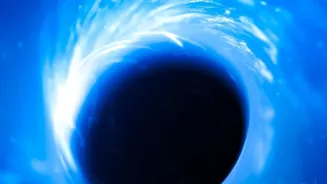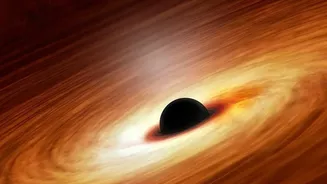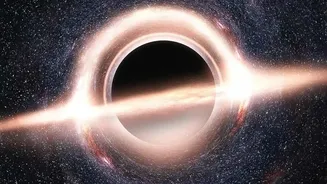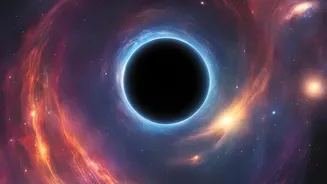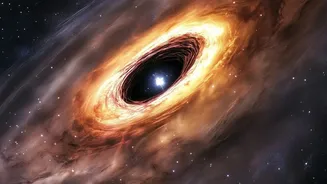




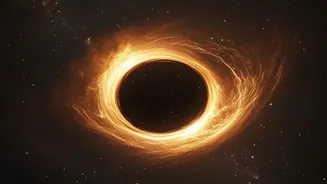

In the cosmic rulebook, black holes are famous for merging, not splitting. But a new theoretical study suggests a startling loophole: a single, extremely fast-spinning black hole might just be able to tear itself in two.
The One-Way Street of Black Holes
For decades, our understanding
of black holes has been fairly straightforward in one respect: they grow. They swallow matter, light, and even other black holes, merging into ever-more-massive objects. This idea is supported by one of the fundamental principles of thermodynamics, the concept of entropy. In simple terms, entropy is a measure of disorder, and in any isolated system, it tends to increase over time. For a typical, non-rotating black hole, splitting into two smaller pieces would actually decrease its total entropy, a process that is thermodynamically forbidden. It's like an egg unscrambling itself — something we just don't see happen. This principle, part of what's known as Hawking's area theorem, has long suggested that black hole mergers are a one-way street.
A Loophole Created by Extreme Spin
The new research, published in the journal Physical Review D, proposes a fascinating exception to this rule. The key, according to the scientists, is extreme rotation. A black hole that is spinning has less entropy than a non-rotating one of the same mass. Researchers from institutions including the University of Southern Denmark and the University of Naples Federico II calculated that if a black hole spins fast enough—close to its absolute maximum theoretical speed—a loophole opens. This extreme spin energy could potentially allow the black hole to fragment, converting its own rotational energy into the orbital energy of two newly formed, smaller black holes. In this very specific scenario, the total entropy of the two new black holes could be greater than the single, spinning original, making the split thermodynamically possible.
The 'Pair-of-Pants' Problem
Even if the energy and entropy calculations work out, there's another major hurdle: the two new black holes would have to escape each other's immense gravity. Otherwise, they would immediately fall back together and merge, negating the split. According to co-author Francesco Sannino, when this requirement is factored in, the window of opportunity for a split 'largely closes again'. The only remaining possibility is for black holes rotating at the very edge of their physical limit. The study's title, 'When Black Holes Admit Pair-of-pants Topologies', refers to the shape the event horizon would make in spacetime if a split occurred. Imagine a single tube (the original black hole) branching into two separate 'legs' (the new black holes), tracing a shape like a pair of trousers through time.
Why This Theory Matters
This research is purely theoretical; no black hole has ever been observed splitting apart. However, it's a vital thought experiment that pushes the boundaries of our understanding of gravity and the cosmos. It forces physicists to probe the limits of Einstein's theory of general relativity and consider what might happen under the most extreme conditions in the universe. While the probability of such an event is still unknown, the researchers suggest that smaller, primordial black holes, theorised to have formed shortly after the Big Bang, might be more likely candidates for splitting than the large astrophysical black holes we commonly observe. Proving this theory would require a monumental effort in observation and a deeper understanding of gravity beyond what we currently have.
The Search for Evidence
So, how could we ever confirm such a bizarre idea? The researchers suggest that the telltale signs of a black hole split might be detectable. The process could release unique signals, potentially in the form of gamma-ray flashes. Observatories like NASA's Fermi-LAT gamma-ray space telescope could theoretically search for these specific signals, which might indicate the formation of tiny black hole fragments. For now, the concept remains a tantalizing possibility that exists only in complex calculations. But in the world of theoretical physics, today's strange mathematics can often become tomorrow's astronomical discovery, reminding us that the universe is likely far stranger and more dynamic than we can currently imagine.