



What Exactly Are Cosmic Rays?
First, let's clear up a common misconception. Cosmic 'rays' aren't rays at all, like light or X-rays. They are actual physical particles—protons, electrons, and atomic nuclei—stripped of their electrons and accelerated to nearly the speed of light. These
subatomic bullets are launched by some of the most violent events in the universe, such as exploding stars (supernovae), active galactic nuclei, and other powerful celestial phenomena. They travel for millions of years across the cosmos, and when they finally reach Earth, they carry clues about their cataclysmic origins. The problem is, these primary cosmic rays almost never reach the ground directly.
The Atmosphere as a Giant Detector
This is where the genius of modern observatories comes into play. Instead of trying to catch the single, elusive primary particle, they use the entire upper atmosphere as a massive detection chamber. When a high-energy cosmic ray smashes into an air molecule, typically 10 to 20 kilometers up, it triggers a chain reaction. The collision shatters the particle and the air nucleus, creating a cascade of secondary particles, including pions, muons, electrons, and photons. These new particles then hit other air molecules, creating even more particles. This rapidly growing cascade is called an 'extensive air shower', and it can spread out over many square kilometers by the time it reaches the surface. By detecting this shower, scientists can reconstruct the properties of the original cosmic ray.
Method 1: Seeing an Invisible Flash
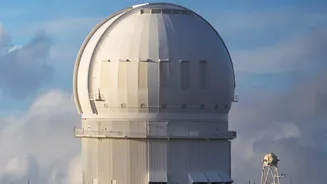
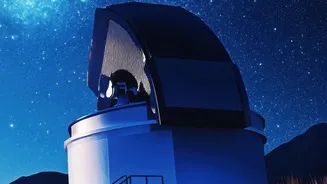
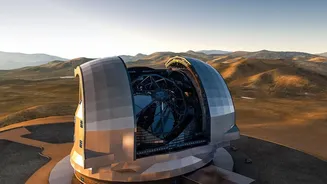
One way to 'see' an air shower is by detecting the faint light it produces. The particles in an air shower are moving so fast that they actually travel faster than the speed of light in air (though not faster than the speed of light in a vacuum). This creates an effect analogous to a sonic boom, but with light. It's called Cherenkov radiation, a faint, blueish-ultraviolet glow emitted in a cone shape along the particle's path. Specialised 'Imaging Atmospheric Cherenkov Telescopes' (IACTs), such as those used by the VERITAS or H.E.S.S. arrays, use massive mirrors to collect this fleeting flash of light. By imaging the shape and intensity of the Cherenkov light from different angles, scientists can determine the direction and energy of the original cosmic ray with incredible precision. Another technique observes the faint fluorescence light emitted when shower particles excite nitrogen molecules in the air.
Method 2: Catching the Particle Footprint
The other primary method involves detecting the shower particles that actually survive the journey to the ground. Giant observatories, like the Pierre Auger Observatory in Argentina, are spread over vast areas—in Auger's case, 3,000 square kilometers. This area is dotted with hundreds of particle detectors. A common type is the water Cherenkov detector: a large tank of highly purified water equipped with sensitive light sensors called photomultiplier tubes. When a particle from the air shower zips through the tank, it again produces Cherenkov radiation, this time in the water, which the sensors record as a tiny flash of light. By timing exactly when each tank in the grid detects particles, scientists can map the shower's 'footprint' on the ground and calculate the direction of the primary particle that started it all.
Why This Research Matters
These complex and massive experiments are more than just a high-tech cosmic shooting gallery. By measuring the energy and arrival directions of the most powerful cosmic rays, scientists are tackling fundamental questions in astrophysics. Where in the universe are these particles being accelerated to such impossible speeds? What can they tell us about the workings of black holes and the lifecycle of galaxies? Some research even uses these particles to search for signs of dark matter or to test the laws of physics at energies far beyond what any particle accelerator on Earth can achieve. Each detected air shower provides another piece of the puzzle, helping us understand the most extreme and energetic processes shaping our universe.