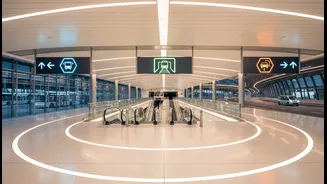









Why Terminal Changes Are Necessary
Navigating a large airport can often feel like a small journey in itself, especially when your connecting flight departs from a different terminal. This is a common scenario in modern air travel for several reasons. Major airports often dedicate separate
terminals to specific airline alliances, differentiate between international and domestic flights, or segregate low-cost carriers from full-service ones. For instance, at Delhi's Indira Gandhi International Airport, some domestic flights operate from Terminal 2 while most, along with all international flights, use the larger Terminal 3. Similarly, Bengaluru's Kempegowda International Airport uses Terminal 1 for certain domestic airlines and Terminal 2 for all international services and other domestic carriers. This operational separation means that if you're connecting from a domestic flight on one airline to an international flight on another, a terminal change is often unavoidable.
First Step: Always Check Your Ticket
The most crucial piece of information is right in your hands: your ticket and boarding pass. Before you even begin your journey, and especially when you land for a connecting flight, double-check the terminal numbers listed for both your arrival and departure. Airlines and airport authorities work to make this information clear, but last-minute gate or terminal changes can happen. Keep an eye on airport display screens and listen for announcements. If your journey involves separate tickets for each leg, it is almost certain you will need to collect your baggage and transfer between terminals landside, which means exiting the secure area and re-entering.
Bus and Shuttle: The Most Common Connector
The most prevalent method for inter-terminal transfers at major Indian airports is a dedicated shuttle bus service. These services are typically complimentary for passengers with a valid boarding pass. Delhi Airport, for example, runs a free shuttle bus every 20 minutes, 24/7, connecting Terminals 1, 2, and 3. Similarly, Mumbai's Chhatrapati Shivaji Maharaj International Airport provides a 24/7 complimentary coach service to bridge the distance between its domestic (T1) and international/domestic (T2) terminals. In Bengaluru, a free shuttle also operates around the clock between T1 and T2 at frequent intervals, a journey that takes about 10-15 minutes. These buses are the workhorses of airport transfers, but it's vital to factor in waiting times and potential traffic, even on airport roads.
Train and Metro Links: The Faster Alternative
Some airports offer the speed and reliability of a rail connection. In India, Chennai International Airport is directly connected to the city's metro system, with the station accessible via a walkway from the terminals. This makes it a viable option for moving between points in the city and the airport, though inter-terminal travel itself is generally handled by other means. Delhi is also planning to introduce an 'air train,' or Automated People Mover (APM), by the end of 2027 to connect its terminals more efficiently and reduce reliance on buses. While not a widespread feature yet, these train links represent the future of seamless airport transit, bypassing road congestion entirely.
By Road: Taxis and Ride-Hailing
When a shuttle isn't available or if you're carrying significant luggage and prefer a direct ride, using a taxi or an app-based service like Uber or Ola is another option. At most airports, you can find prepaid taxi counters or designated pickup points for ride-hailing apps. This option offers convenience but comes at a cost. The terminals at Mumbai's airport, for example, are a few kilometers apart, and a taxi ride can take 25-30 minutes depending on traffic. In Delhi, the distance between T1 and T3 is about 8 km, making a cab a practical choice if you miss a shuttle. This is generally a last resort for transferring passengers but can be a necessary alternative if you are running very late.
Plan Your Transfer Time Wisely
The golden rule of terminal transfers is to allow more time than you think you need. For domestic connections, especially those involving a terminal change, a layover of at least two to three hours is advisable. For international connections, this should be extended to three to four hours. This buffer accounts for potential flight delays, disembarking, walking through large terminals, waiting for a shuttle bus, the transfer journey itself, and clearing security and immigration again. At Bengaluru, for instance, it's recommended to have at least 45 minutes just for the terminal transfer process, excluding time for check-in and security. Being prepared can make the difference between a frantic sprint and a relaxed walk to your next gate.