




Meet the Peculiar Galaxy
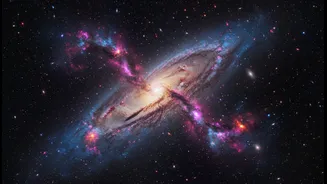
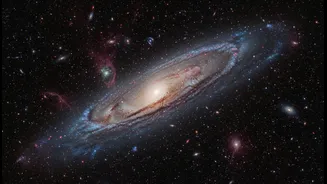
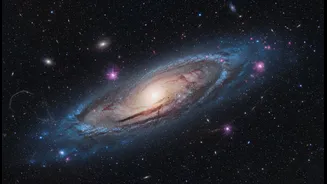
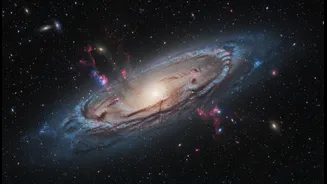
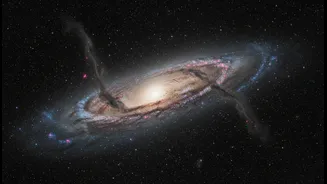
Centaurus A, also known as NGC 5128, is not your average spiral or elliptical galaxy. Located about 11 million light-years from Earth, it’s one of the closest active galaxies to us. Its most striking feature is a thick, dark lane of dust that cuts across
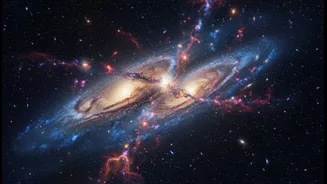
its bright centre, giving it a unique and disturbed appearance. For decades, astronomers have known this peculiar shape is the scar of a dramatic event: a collision with another, smaller galaxy that happened roughly two billion years ago. That cosmic merger left Centaurus A in a state of beautiful disarray, scattering gas, dust, and stars, and setting the stage for the complex processes we see today.
A Tale of Two Feasts
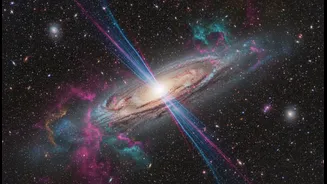
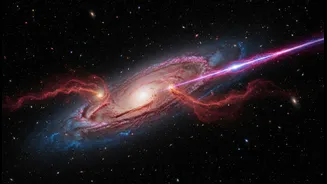
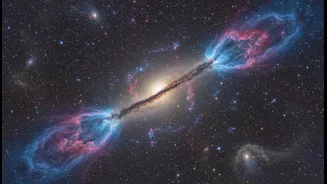
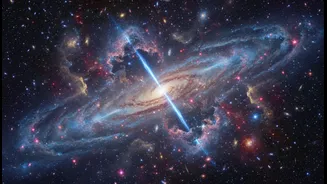
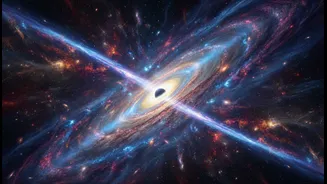
The galactic collision was more than just a destructive crash; it was a delivery of raw materials. The vast amounts of gas and dust dumped into Centaurus A became the fuel for two powerful cosmic engines. Firstly, this material ignited furious bursts of star formation, creating stellar nurseries where new suns are born. Secondly, and crucially, the same gas and dust funnelled down towards the galaxy's core, feeding the supermassive black hole that resides there. This process turns the black hole into an 'active galactic nucleus' (AGN), a ferociously bright and energetic region that blasts out powerful jets of plasma into space. The collision, therefore, directly links the galaxy's structure to the activity of its central black hole.
Webb’s Infrared Vision Changes Everything
Previous telescopes like Hubble struggled to see the full picture because the dense dust lanes blocked their view in visible light. The retired Spitzer Space Telescope could see in infrared but lacked the sharpness to resolve fine details. This is where the James Webb Space Telescope (JWST) represents a monumental leap forward. Its powerful instruments can peer through the obscuring dust with unprecedented clarity. The new images don't just show glowing dust; they resolve millions of individual stars, even within the crowded galactic core. This allows scientists to perform a kind of 'galactic archaeology,' studying different generations of stars to build a timeline of events before, during, and after the merger.
Connecting the Dots: Gas, Stars, and Jets
With its new view, Webb is providing the missing evidence connecting the collision to the black hole's influence. Astronomers can now trace the motion of gas within the galaxy. They can see how the black hole’s powerful jets push material outwards, which has a dual effect. In some areas, the jets compress gas, triggering the birth of new stars. In other areas, the jets blow the raw material away entirely, effectively shutting down star formation. This complex feedback loop—where the black hole both gives and takes away—is fundamental to understanding how galaxies evolve, and Centaurus A is the perfect nearby laboratory to study it. The image even reveals mysterious, S-shaped dust structures near the core that scientists are now racing to explain.