






Know Your Climate and Variety
Before you begin, it’s crucial to understand that kiwis are not suited for all Indian climates. They thrive in regions with cool winters, needing between 700 to 800 chilling hours—where temperatures stay at or below 7°C—to flower and produce fruit. This
makes them ideal for the mid-hills of states like Himachal Pradesh, Uttarakhand, Sikkim, and Arunachal Pradesh. If you live in a suitable zone, your next step is choosing a variety. Most kiwi plants are dioecious, meaning you need separate male and female plants for pollination. The 'Hayward' (female) is a popular commercial choice, known for its large fruit, and it pairs well with the 'Tomuri' (male) pollinator. For every eight female plants, one male plant is recommended. Some self-fertile varieties exist, but they are less common for the larger, fuzzy fruit type.
Soil Preparation and Planting
Kiwifruit vines require deep, well-drained, sandy loam soil that is rich in organic matter. They prefer a slightly acidic pH, ideally between 6.0 and 6.5. If your soil is heavy or alkaline, amend it with compost to improve drainage and adjust the pH. The best time for planting is January. Dig pits well in advance, around December, and enrich the soil with plenty of farmyard manure. When planting a sapling from a nursery, be careful not to disturb the root ball too much. Space the vines about 4 to 6 metres apart, depending on the support system you plan to use, to give them ample room to grow.
Build a Sturdy Support System
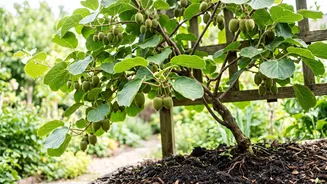
Kiwis are vigorous climbing vines that become very heavy with foliage and fruit, so a strong support structure is non-negotiable. A T-bar trellis or a pergola are the most common and effective systems. A T-bar trellis typically consists of posts about 6 feet high with a cross-arm at the top, strung with several wires. This structure allows you to train the main vine up the post and then guide permanent branches, or 'cordons', along the wires. This setup not only supports the plant's weight but also ensures good air circulation and sunlight exposure, which are vital for fruit development and disease prevention.
Training and Pruning Your Vines
Training begins as soon as you plant. Guide a single strong shoot straight up your support post, tying it loosely as it grows. Once it reaches the top wires, you can begin training the main lateral branches. Pruning is essential for managing growth and encouraging fruit production. The main structural pruning should happen in late winter when the vine is dormant. This involves removing wood that has already fruited (kiwis bear fruit on one-year-old wood), thinning out crowded canes, and selecting new canes for the upcoming season's crop. A second, lighter pruning is done in the summer to control vegetative growth and ensure sunlight reaches the developing fruit.
The Secret to Fruit: Pollination
Since you will have separate male and female plants, pollination is a critical step. While bees are natural pollinators, kiwi flowers don't produce nectar, so they aren't a top choice for bees. To guarantee a good fruit set, hand pollination is highly recommended, especially for home growers. When the flowers open, collect a male flower and gently brush it against the centre of several female flowers to transfer the pollen. A single male flower can be used to pollinate seven or eight female flowers. A successfully pollinated fruit will be larger and more symmetrical.
Watering, Feeding, and Harvesting
Kiwi vines have shallow roots and require consistent moisture, especially during the dry summer months, so regular watering is key. Feed your vines annually. A balanced fertiliser rich in nitrogen and potassium is ideal. Apply it in two doses: once in late winter before growth starts, and again after the fruit has set in the spring. Your vines will likely take three to four years to start producing fruit, so patience is essential. The fruit is typically ready to harvest in late autumn or early winter when the skins turn brown and the fruit feels slightly soft to the touch. They can be picked when still firm and allowed to ripen off the vine indoors.