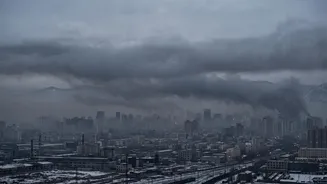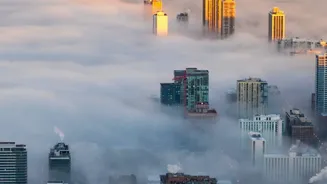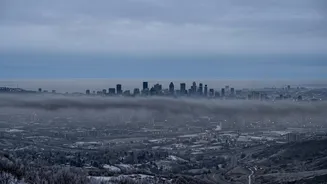






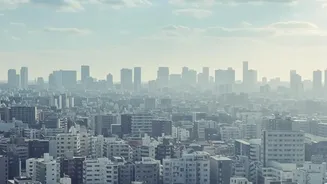
As winter settles over many Indian cities, a familiar, thick haze descends, and air quality apps flash red. This isn't just about cold weather; it's about a specific atmospheric phenomenon that puts an invisible lid over our cities.
The Atmosphere's Usual Cleanup Crew
On a normal day, the
air works like a giant conveyor belt for pollution. The sun warms the ground, which in turn warms the layer of air closest to it. This warm, less dense air rises, carrying pollutants from traffic, industry, and other sources with it. As it goes higher, it cools and disperses into the wider atmosphere. This vertical mixing is crucial for clearing the air we breathe at ground level. It’s a constant, natural process of ventilation that prevents pollutants from building up to dangerous concentrations.
When The Air Puts A Lid On Itself
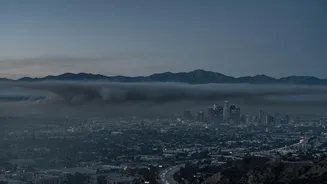
A temperature inversion flips this entire process on its head. It occurs when a layer of warmer air settles above a layer of cooler, denser air near the ground. This warm air acts like an invisible lid, or a cap, on the atmosphere. The cooler air below, which is heavy and laden with pollutants, is trapped. It cannot rise and disperse. This effectively seals the city and its surrounding areas under a dome of its own emissions, a phenomenon particularly common during winter.
Winter Nights: The Perfect Recipe for an Inversion
Winter provides the ideal conditions for these inversions to form. After sunset, the ground rapidly loses heat, especially on clear, calm nights. This process cools the air at the surface, making it dense and heavy. However, the air higher up remains relatively warm. The weak winter sun struggles to warm the ground enough the next day to break this cycle, meaning the inversion can persist for hours or even days. Low wind speeds during this season further prevent the horizontal mixing of air, allowing the stagnant, polluted air mass to build day by day.
Creating a Toxic Air Bubble
An inversion doesn't create pollution, but it is brutally effective at trapping it. Emissions from vehicles, industrial activity, construction dust, and burning biomass for warmth are all released into this shallow layer of trapped cold air. With nowhere to go, concentrations of harmful pollutants like fine particulate matter (PM2.5), nitrogen oxides (NOx), and volatile organic compounds (VOCs) skyrocket. This is why an Air Quality Index (AQI) reading can jump from 'Moderate' to 'Severe' overnight, even if the amount of pollution being generated hasn't drastically changed. The longer the inversion lasts, the more these pollutants accumulate, leading to the hazardous air quality that defines much of the winter in northern India.
India's Compounding Factors
In India, particularly across the Indo-Gangetic Plain, geographical features intensify the effect of temperature inversions. The vast plain is bordered by the Himalayas to the north, which acts as a massive wall, blocking the escape of polluted air. This creates a 'valley' or 'bowl' effect that contains the air mass. This meteorological trap is compounded by a surge in seasonal pollution sources, most notably poststmonsoon crop residue burning in states like Punjab and Haryana, whose smoke travels and settles across the region under the inversion lid. The combination of geography, seasonal emissions, and the predictable science of temperature inversions creates a perfect storm for the severe air quality crises seen in cities like Delhi each winter.