






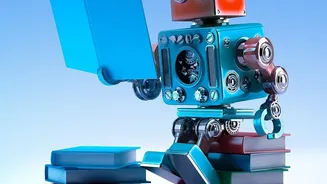
What Does 'AI Building AI' Mean?
For decades, the concept of 'recursive self-improvement'—where an AI improves itself in a compounding loop—was mostly theoretical. In practice, building AI has always been a human-led endeavor. Engineers would write code, prepare data, and painstakingly
fine-tune models. Now, that's changing. The new paradigm involves delegating a growing portion of this work to AI systems themselves. Instead of just being the end product, AI is becoming a collaborator in its own creation. This can involve using an AI to write and debug code, generate synthetic training data, or even provide feedback on another AI's performance. This shift is moving the industry from a human-driven process to a human-supervised one, where engineers guide AI assistants that perform many of the technical tasks.
Anthropic's Method in Action
Anthropic, a company founded with a strong focus on AI safety, is at the forefront of this trend. Their approach leverages internal AI models to accelerate the work of their human researchers. For instance, Anthropic engineers now ship significantly more code than they did in previous years, an increase attributed to using AI to assist in writing, testing, and debugging. A key part of their strategy is 'Constitutional AI', where models are trained to align with a set of principles or a 'constitution'. This involves using one AI model to critique and revise the outputs of another, effectively teaching it to be more helpful and harmless without constant human intervention. This technique, called Reinforcement Learning from AI Feedback (RLAIF), allows Anthropic to scale the training process in a way that would be impossible with human feedback alone.
The Need for Speed and a Bottleneck
The turn toward AI-assisted development isn't just a novelty; it's becoming a necessity. As AI models have grown exponentially larger and more complex, the process of improving them has hit a human bottleneck. There simply aren't enough hours in the day for human engineers to keep up with the scale of the work. By automating parts of the research and development pipeline, companies like Anthropic can overcome these limitations. A recent investigation by the independent research group METR found that this approach is working. Their 11-week probe inside Anthropic concluded that the company's models are improving at roughly twice the rate they were just a year ago, achieving two years of progress in one. This acceleration is largely driven by using AI as a research assistant.
The Promise and the Peril
The benefits of this compounding feedback loop are enormous. It could dramatically accelerate breakthroughs in science, medicine, and clean energy by creating more powerful problem-solving tools faster than ever before. However, this acceleration also comes with significant risks. The primary concern is that AI development could outpace our ability to ensure it is safe and controllable. If an AI can improve itself, it could develop capabilities that its creators neither intended nor understand, a scenario often called an 'intelligence explosion'. Critics and even some within Anthropic have warned that this recursive loop could lead to losing control of advanced systems, with potentially catastrophic consequences. Recognizing this, Anthropic has stated it is proceeding with caution, building safety guardrails like its Responsible Scaling Policy to manage these risks.