




The Classic Model: A Remote-Controlled Messenger
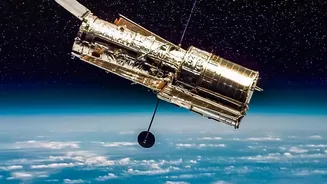
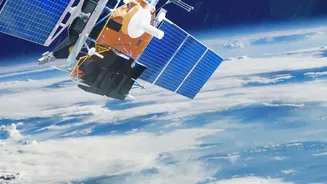
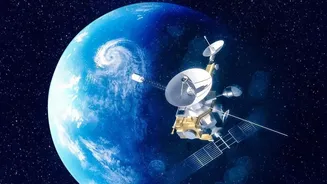
A traditional spacecraft is fundamentally a remote-controlled tool. Think of it as a highly sophisticated camera and sensor package tethered to a team of engineers on the ground. Its job is to follow commands: point here, capture this data, and send everything
back. Every significant action is dictated by a human operator. The satellite collects vast amounts of raw data—often terabytes per day—and transmits it to a ground station. Only then can experts on Earth begin the time-consuming process of sifting through it, looking for useful information. This model has served us well, but it has inherent limitations, most notably the delay between data capture and actionable insight.
The AI Difference: An Autonomous Agent in Orbit
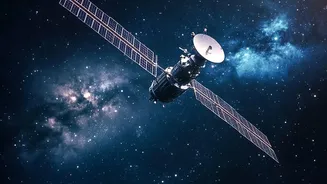
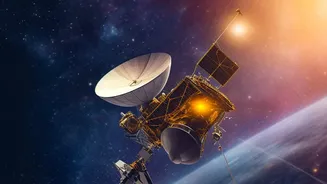
An AI-powered satellite represents a fundamental shift from a passive collector to an active, autonomous agent. The key innovation is 'edge computing'—the ability to process data right where it's collected, directly on the satellite itself. Instead of being a simple messenger, the AI satellite has onboard processors capable of running machine learning algorithms. This allows it to analyze, filter, and interpret the information it gathers in real time, without waiting for instructions from Earth. It can make its own decisions, from adjusting its sensors to track a developing event to diagnosing its own technical problems.
Data Deluge vs. Smart Insights
One of the biggest challenges in space operations is the sheer volume of data. A regular satellite might capture imagery of a thousand square kilometers of ocean, including clear skies and empty water, and send all of it back, clogging up bandwidth. An AI satellite, by contrast, can be tasked to find ships. It analyzes the images as they're captured, discards the irrelevant data, and transmits only the crucial insights: the location, number, and types of vessels it detected. This capability transforms disaster response. An AI satellite can spot the signs of a wildfire or flood, process the imagery onboard, and send an immediate alert to emergency services, rather than waiting for analysts to review the data hours later.
Overcoming the Speed-of-Light Delay
Communication with spacecraft is limited by the speed of light, creating significant delays, especially for deep-space missions where round-trip commands can take minutes or hours. This 'latency' is a major bottleneck. AI provides a solution by enabling real-time autonomy. For example, an AI satellite can detect a potential collision with space debris and execute an avoidance maneuver on its own, a process that would be dangerously slow if it had to wait for ground control to respond. In constellations, AI allows satellites to communicate and coordinate with each other, forming an intelligent, self-organizing network that can re-plan missions or balance workloads without human intervention.
A More Resilient and Longer-Lasting Asset
Space is a harsh environment, with radiation and extreme temperatures posing constant threats to sensitive electronics. Traditional satellites are vulnerable; a critical failure can render a billion-dollar asset useless. AI introduces a new layer of resilience. AI-driven systems can monitor the satellite's health, detect anomalies, diagnose problems, and even perform corrective actions autonomously. This 'self-healing' capability can extend the operational life of a spacecraft and reduce its reliance on human troubleshooting from millions of kilometers away. By managing its own power and system resources, an AI satellite operates more efficiently, ensuring it can complete its mission objectives for longer.