


A Groundbreaking Glimpse
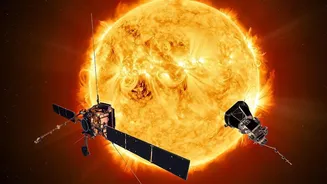
Scientists have announced a landmark discovery that could change our fundamental understanding of the Sun. Using the Daniel K. Inouye Solar Telescope in Hawaii, researchers have captured the highest-resolution images ever of the Sun's surface, known as
the photosphere. These incredible images revealed something long theorised but never before seen directly: tiny, whirlpool-like vortices of plasma swirling at the edges of the Sun's bubbling structures. These patterns are the tell-tale sign of a process called the Kelvin-Helmholtz instability, which occurs when two fluids flowing at different speeds slide past each other, creating a shear force that results in swirling waves. This phenomenon is seen on Earth in breaking ocean waves and cloud formations, but witnessing it on our star for the first time is a major breakthrough.
What are These Tiny Vortices?
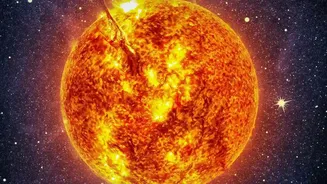
The Sun's surface is a dynamic and violent place, covered in a pattern of 'granules' which are bubbling cells of hot plasma rising from the interior, cooling, and sinking back down. Each granule can be hundreds to thousands of kilometres across. The newly discovered vortices are incredibly small by solar standards, with some measuring just over 20 kilometres wide. To put this achievement in perspective, observing these is like spotting a one-rupee coin from a distance of 180 kilometres. These swirls happen at the edges of the granules, where plasma is flowing at different speeds, creating the perfect conditions for the Kelvin-Helmholtz instability to take hold and generate these vortices.
Solving a Burning Mystery
This discovery offers vital clues to one of solar physics' most persistent mysteries: the coronal heating problem. The Sun’s surface is about 5,500 degrees Celsius, but its outer atmosphere, the corona, is hundreds of times hotter, reaching millions of degrees. Scientists have long puzzled over what transport mechanism could carry enough energy to heat the corona so intensely. These newly seen vortices could be a key piece of the puzzle. The twisting motions are seen as 'motors' that build up magnetic energy, which can then be transported and released into the corona as heat. By observing how these small-scale processes move energy around, scientists can build better models to explain the extreme temperatures of the Sun's atmosphere.
Why It Matters for India and the World
Understanding the Sun isn't just an academic exercise. The same explosive releases of energy that heat the corona also drive 'space weather'—the stream of charged particles and radiation that flows from the Sun. Powerful solar storms can have significant impacts here on Earth, disrupting satellite communications, disabling GPS systems, and even overloading national power grids. For a technologically advancing nation like India, which relies heavily on satellite technology for communication, navigation, and security, the ability to accurately predict space weather is crucial. This new discovery, which was made with contributions from researchers at institutions like the Tata Institute of Fundamental Research (TIFR), helps refine the physical models used to forecast these solar events. Better understanding of the Sun's magnetic energy buildup allows for more accurate warnings about potentially disruptive solar activity.