






More Than Just Dust
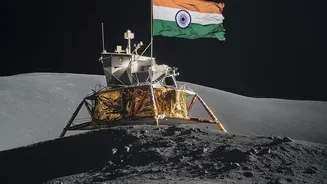
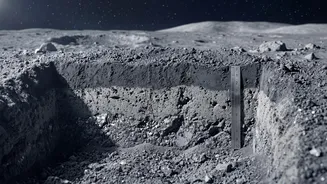
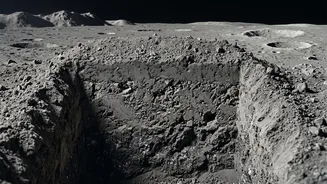
The surface of the Moon, long thought to be a relatively uniform blanket of fine dust and rock known as regolith, is proving to be far more complex. Analysis of data from the Vikram lander has revealed a distinct, cake-like layering within the top 10
centimetres of the soil at its landing site, Shiv Shakti Point. A recent analysis published on November 17, 2026, identified three separate layers, each with its own physical and thermal properties. This fine-scale layering was not observed by previous lunar missions and has upended expectations about the composition of the shallow subsurface in the Moon's south polar region.
A Tale of Three Layers
The discovery was made possible by the Chandra’s Surface Thermophysical Experiment (ChaSTE) instrument, a probe that penetrated the lunar soil. The findings detail a highly porous top layer, about 3 cm deep, that is light and fluffy like dry flour. Below this is a middle layer, from 3 to 6 cm, that conducts heat more effectively. Finally, a third, much denser and more cohesive layer is found between 6 and 10 cm deep. Scientists at ISRO described the difference in consistency as akin to an astronaut walking on dry flour, only to find it behaving like damp, stiff clay just a few centimetres deeper. The density of the soil more than doubles from the top layer to this deeper one.
How the Discovery Was Refined
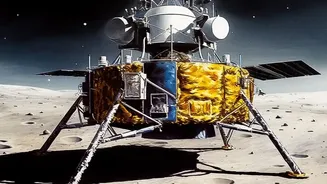
This detailed three-layer profile comes from an analysis of the original landing site. Interestingly, an earlier two-layer structure was identified thanks to Vikram’s unexpected 'hop' manoeuvre on September 3, 2023. In that test, the lander fired its engines and lifted itself about 40 cm before landing again. The engine blast blew away the top 2-3 cm of loose soil, giving ChaSTE a direct look at the compacted layers underneath. By combining data from both before and after the hop, scientists from the Physical Research Laboratory in Ahmedabad were able to piece together the complete, three-tiered structure of the soil.
A Story Written by Asteroids
What could create such distinct layers? The leading theory points to the Moon’s violent past. The south polar region is a rugged, heavily cratered landscape. Researchers propose that successive impacts from nearby craters may have deposited layers of ejected material, or 'ejecta', over billions of years. Each impact would have thrown out material with different properties, which then settled over the landing site, creating the stratified profile that Chandrayaan-3 has now measured. It’s a geological story told in layers of dust and rock, revealing a history of bombardment that has shaped the lunar surface.
Why This Matters for Future Missions
This discovery is more than just a geological curiosity; it has profound implications for the future of lunar exploration. Understanding the soil's properties is crucial for designing habitats, rovers, and other infrastructure for a potential Moon base. The high cohesiveness of the deeper soil, for example, changes engineering calculations for foundations and excavation. Furthermore, the thermal properties of these layers are vital. The top layer acts as a powerful insulator, with ChaSTE recording a dramatic temperature drop of 50-60°C over just a few centimetres. This insulating blanket could play a key role in the stability and preservation of water ice believed to be trapped below the surface, a resource essential for sustaining a human presence on the Moon.