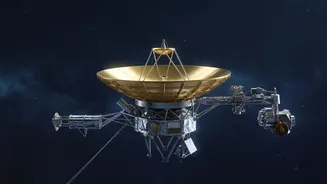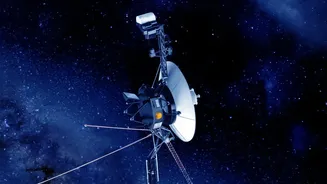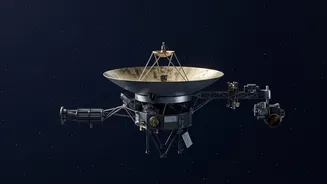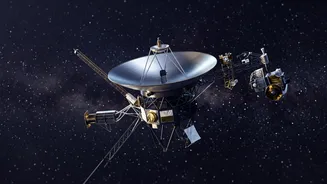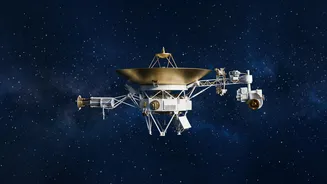




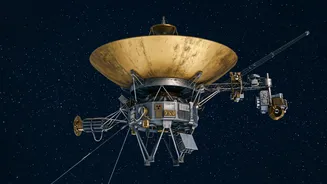
On November 18, a machine launched when Jimmy Carter was president will achieve something unprecedented. Voyager 1, humanity’s farthest emissary, will be one light-day from Earth, a testament to nearly 50 years of relentless travel.
What is a Light-Day?
A light-day isn’t a measure
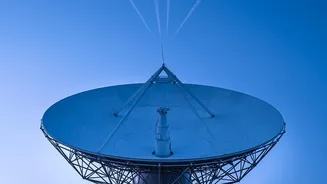
of time, but of immense distance. It’s how far a particle of light travels in a vacuum in 24 hours: approximately 25.9 billion kilometres. To put that in perspective, light from our Sun takes just over eight minutes to reach Earth. The distance to Neptune, our solar system's most distant planet, is only about four light-hours. This new milestone for Voyager 1 means that a radio signal sent from NASA's Deep Space Network will take a full 24 hours to reach the spacecraft, and another 24 hours for a response to return. A simple 'hello' and its reply will span two full days.
A Grand Tour for the Ages
Launched on September 5, 1977, just 16 days after its twin, Voyager 2, Voyager 1’s initial mission was to explore the outer solar system. Originally designed to last just five years, its journey has become one of history's greatest tales of exploration. In 1979, it flew by Jupiter, revolutionising our understanding of the gas giant. It discovered the planet's faint ring system, two new moons (Metis and Thebe), and, most shockingly, active volcanoes erupting on the moon Io—the first ever observed beyond Earth. By November 1980, it reached Saturn, providing detailed images of its complex rings, discovering five new moons, and studying the thick, nitrogen-rich atmosphere of its largest moon, Titan.
Into the Great Unknown
After its Saturn flyby, Voyager 1's trajectory sent it hurtling out of the plane of the solar system. In February 1990, at the urging of astronomer Carl Sagan, it turned its cameras around one last time to capture the iconic 'Pale Blue Dot' image, showing Earth as a tiny speck from 6.4 billion kilometres away. By 1998, it surpassed Pioneer 10 to become the most distant human-made object. Then, in August 2012, it made history again by crossing the heliopause—the boundary where the Sun's influence gives way to the interstellar medium—officially entering interstellar space. It is now travelling at roughly 61,000 kilometres per hour, headed toward a star called Gliese 445, which it will pass in about 40,000 years.
A Faint Whisper from the Void
Communicating with a nearly 50-yearnd probe billions of kilometres away is a monumental challenge. Its computers have just 68 kilobytes of memory, and its signal is incredibly faint. The mission has faced increasing difficulties, from a dwindling power supply to aging hardware. Engineers have had to get creative, shutting down instruments and implementing clever power saving manoeuvres to extend its life. Recently, in October 2026, the probe gave its controllers a scare when it fell silent for 48 hours before autonomously resolving a communications glitch and resuming contact. These events underscore the incredible resilience of a machine that continues to send back valuable data from the darkness between the stars.
A Message in a Cosmic Bottle
Attached to Voyager $^$ is a message for any civilization that might one day find it: the Golden Record. This $^$inch,$^$gold-$^$plated copper disc contains a time capsule of life on Earth. Curated by a team led by Carl Sagan,$^$it includes $^$$images,$^$a variety of natural sounds (from wind and thunder to animal calls), musical selections from across cultures,$^$and greetings in $^$$ different languages.$^$It even carries a recording of the brainwaves of writer Ann Druyan.$^$While the chances of it being found are minuscule,$^$the Golden Record is a profound symbol of humanity's hope and curiosity—a greeting sent to the cosmos.