
Cosmic Messengers From Afar
For nearly all of human history, everything we studied in the sky belonged to our own solar system, gravitationally bound to our Sun. That all changed in 2017 with the discovery of 1I/ʻOumuamua, the first confirmed object to visit us from another star.
These interstellar visitors travel for millions or even billions of years through the void between stars before passing through our neighborhood. Scientists can identify them by their incredible speed and trajectory; they move so fast that our Sun's gravity cannot capture them into a stable orbit. Instead, they follow a hyperbolic path, swinging by the Sun before heading back out into deep space, never to return. Each one is a fleeting opportunity, a precious sample from another planetary system delivered right to our doorstep.
A Tale of Three Visitors
To date, astronomers have confirmed three interstellar visitors. The first, ʻOumuamua (a Hawaiian name for 'a messenger from afar arriving first'), was a bizarre, cigar-shaped object that baffled scientists. It showed no signs of a comet's typical gassy halo, or coma, yet it accelerated away from the Sun in a way that suggested outgassing was pushing it. The second, 2I/Borisov, discovered in 2019, was more familiar. It looked and behaved much like the comets from our own system, complete with a visible coma and tail. Its composition, however, was unique, containing a much higher concentration of carbon monoxide than any comet seen before, suggesting it formed in an extremely cold region of its home star system. Most recently, 3I/ATLAS was discovered in the summer of 2025, offering another chance for close study. This comet, which could be older than our own solar system, was found to be emitting gases like cyanide and even nickel vapor, providing more clues about its distant origins.
A Sample of an Alien World
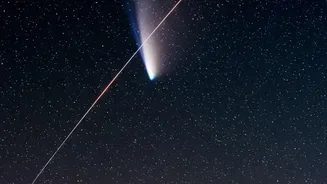
So, why is this so important? Studying comets in our own solar system, like the memorable Comet C/2019 Y4 (ATLAS) which dramatically disintegrated in 2020, tells us about our own cosmic origins. These comets are leftover building blocks from the formation of our giant planets. Interstellar objects, by extension, are free samples of the building blocks of planets around other stars. By analyzing the light from these visitors, scientists can determine their chemical makeup. This is like performing geological fieldwork on an alien world without ever leaving our solar system. The composition of objects like 2I/Borisov and 3I/ATLAS gives us direct insight into the chemistry of distant protoplanetary disks, the nurseries where new planets are born. This helps astronomers test and refine their theories about whether planet formation is a universal process or if it varies wildly from one star system to another.
Answering the Biggest Questions
The data gathered from these fleeting encounters helps address some of the most fundamental questions in science: How are planetary systems built? Are the ingredients for life, like water and carbon-based molecules, common throughout the galaxy? Comets in our own system are thought to have delivered these essential components to early Earth. Finding that interstellar comets also carry them would suggest that the potential for life could be widespread. The unusual nature of ʻOumuamua and the distinct chemistry of Borisov show that other solar systems may construct their planets differently than ours did. 3I/ATLAS adds another vital data point to this growing field. Each new visitor allows us to build a more complete picture of the galaxy's chemistry and the variety of worlds it might contain.