



A Journey Beyond Pluto
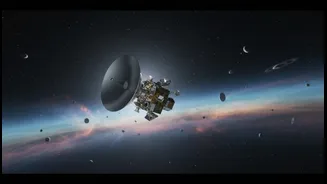
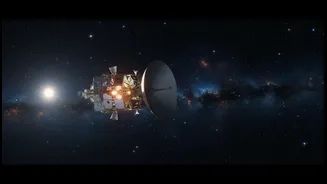
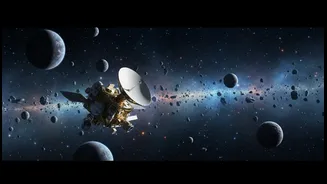
Launched in 2006, NASA's New Horizons spacecraft became a household name in 2015 when it completed humanity's first-ever close-up exploration of Pluto. The stunning images and data it sent back transformed our view of the dwarf planet from a fuzzy dot
into a complex world of ice mountains and nitrogen glaciers. But Pluto was just the beginning. After that historic encounter, the mission was extended, sending the probe deeper into the Kuiper Belt, the vast, icy frontier of our solar system. In 2019, it reached Arrokoth, the most distant object ever explored up close. Now, billions of kilometres from home, it continues its voyage into the unknown.
The Logic of a Deep Space Nap
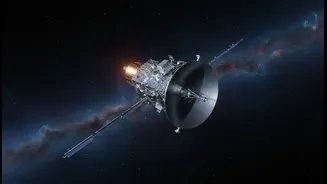
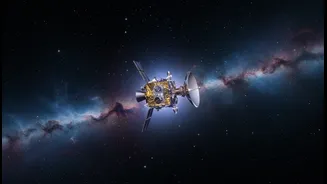
To endure such a long and distant journey, New Horizons relies on a crucial strategy: hibernation. Mission operators at the Johns Hopkins Applied Physics Laboratory routinely place the spacecraft into a resource-saving sleep mode. During these long periods, which can last for many months, most of the probe's systems are powered down, reducing wear and tear and conserving precious energy from its radioisotope power source. It's a method of extending the spacecraft's life and reducing the costs of mission operations for the long cruise phases between scientific activities. The most recent hibernation was its longest yet, lasting 321 days.
A Signal from Billions of Kilometres Away
The wake-up call is a delicate process. Commands sent from Earth last year instructed the onboard computer to reawaken the probe in June 2026. Due to the immense distance—now nearly 9.5 billion kilometres—the confirmation signal took almost nine hours to travel back to Earth at the speed of light. Upon receiving the signal, mission controllers confirmed the probe was in good health, with weekly status reports during hibernation all coming back 'green'. Now fully active, the team can begin downloading health data and, most importantly, the scientific observations collected while it was cruising.
Decoding the Universe's Faintest Light
The headline science for this mission phase revolves around spectrometry. In simple terms, spectrometry is the science of analyzing light by splitting it into its component wavelengths, much like a prism creates a rainbow. Each element and compound absorbs and reflects light in a unique way, creating a specific spectral "fingerprint." New Horizons is equipped with sophisticated instruments, including the Ralph telescope with its LEISA spectrometer, designed to read these fingerprints. This allows scientists to determine the composition of distant objects and even the space environment itself.
The Rarest Data in the Solar System
What makes New Horizons' current work so rare is its unique vantage point. Here on Earth, and even for the Hubble Space Telescope, our view of the wider universe is contaminated by a faint glow called zodiacal light, which is sunlight reflecting off dust within our solar system. At its extreme distance, New Horizons has flown beyond most of this dust, giving it access to the darkest sky ever observed. This empowers scientists to measure the Cosmic Optical Background (COB)—the faint, collective light from all the galaxies in the universe. These measurements, using the LORRI instrument, are incredibly difficult to make from anywhere else and provide a fundamental check on our models of how many galaxies exist and how the universe is structured.
A New Purpose in the Twilight Zone
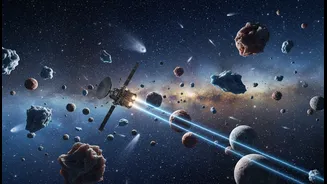
Beyond measuring the COB, New Horizons acts as a solitary deep-space observatory. Its plasma and dust instruments continue to gather data around the clock, even during hibernation, monitoring the outer heliosphere—the vast bubble of influence created by our Sun—and the particle environment of the Kuiper Belt. This provides an unprecedented record of conditions at the edge of our solar system, a region that has only been crossed by the older Voyager probes, which lack the modern instruments of New Horizons. Each wake-up period marks a new campaign to maximize the scientific return from this one-of-a-kind mission.