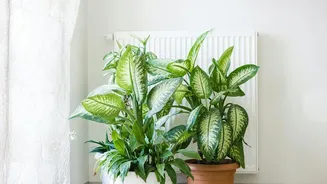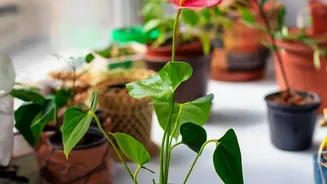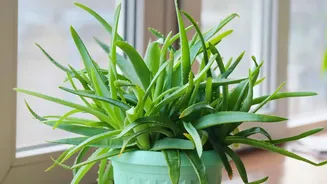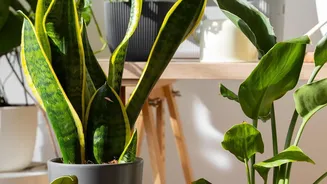





Ever notice your favourite houseplant starting to lean, reaching desperately for the window? This common plant behaviour has a simple scientific explanation and an equally simple fix that can make all the difference for its health and appearance.
The Science of the Lean
The phenomenon
of a plant growing toward its light source is called phototropism. This isn't just a quirky habit; it's a vital survival mechanism. Plants use photosynthesis to convert light into energy, and to do this effectively, they need to maximize their leaves' exposure to sunlight. This directional growth is driven by a powerful plant hormone called auxin. Auxin is produced at the tip of the stem and influences how much cells elongate. When light shines on one side of a plant, the auxin concentrates on the shadier side. This buildup of auxin causes the cells on the dark side of the stem to grow longer and faster than the cells on the sunny side. This difference in growth rates is what causes the stem to bend and appear to 'lean' toward the light.
Why Rotation Is a Good Habit
In nature, sunlight changes position throughout the day, but indoors, the primary light source—usually a window—is fixed. Without intervention, your plant will continuously grow in one direction, leading to a lopsided and potentially weaker structure. Rotating your plants counteracts this by distributing light evenly. This encourages balanced, symmetrical growth, resulting in a fuller, more aesthetically pleasing plant. Strong, even growth isn't just about looks; it contributes to stronger stems and overall plant vigour. Furthermore, exposing all parts of the plant to light can stimulate new shoots and leaves in previously shaded areas. Regular rotation is also a great opportunity to inspect your plant for pests, dust, or signs of stress, allowing you to catch potential problems early.
How and When to Rotate
There is no single, rigid rule for how often to rotate your plants, but consistency is key. A widely recommended and easy-to-remember method is to give your plant a quarter-turn each time you water it. This gentle, regular adjustment ensures all sides of the plant get their turn in the sun over time. For plants in lower-light conditions, more frequent turns—perhaps every few weeks—might be beneficial. Conversely, those in very bright spots may only need rotating every few months. The key is to observe your plant. If you notice it starting to lean, it's time for a turn. If it has already developed a significant lean, you can correct it by turning the less-developed side to face the light, and it will gradually straighten out.
Are There Exceptions to the Rule?
While most common houseplants benefit from rotation, there is a counter argument that constant adjustment can be stressful for the plant, forcing it to repeatedly redirect its energy. Some experts argue that letting a plant establish a 'front' (the side facing the light) and a 'back' mimics its natural growth pattern and can lead to a stronger, more established structure, even if it's asymmetrical. This is particularly true for vining or trailing plants like pothos and philodendrons, whose natural cascading growth isn't dependent on symmetry. Forcing them to change direction can interrupt their flow. Ultimately, whether to rotate is a choice between encouraging a perfectly symmetrical look and allowing the plant to follow its natural instincts. For most growers aiming for a balanced appearance, rotation remains a beneficial practice.