


The Cosmic Hunt for Habitable Worlds
For centuries, we’ve looked to the stars and wondered if we are alone. Today, that question is a driving force in modern astronomy. Scientists have discovered thousands of exoplanets—planets orbiting stars other than our Sun. While finding these planets is a feat
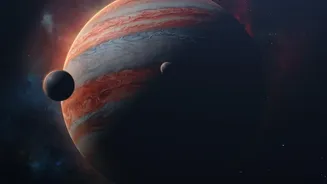
in itself, the real prize is understanding what they are like. Are they rocky like Earth or gaseous like Jupiter? More importantly, do they have atmospheres, and what are those atmospheres made of? Finding water vapour is a critical first step, as it's a key ingredient for life as we know it. The presence of water could signal that a planet has the potential for liquid oceans and, just maybe, life.
Decoding Starlight with Spectroscopy
To find this water from trillions of kilometres away, astronomers use a technique called spectroscopy. Think of it like a cosmic barcode scanner. When light from a star passes through a prism, it splits into a rainbow of colours, called a spectrum. But if that starlight first passes through a planet's atmosphere, something interesting happens. Molecules in the atmosphere, like water vapour, absorb very specific colours, or wavelengths, of light. This leaves tiny, dark lines in the star's rainbow. Each molecule has its own unique barcode-like pattern. By looking for the specific barcode of water, scientists can confirm its presence.
The Transit Method: A Planet's Shadow
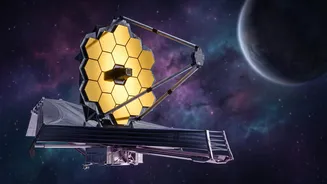
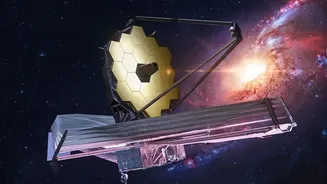
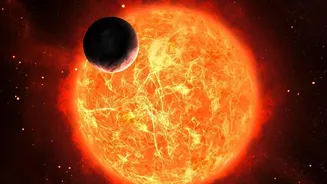
The JWST uses a clever trick called transmission spectroscopy to get this data. It patiently waits for an exoplanet to transit, or pass in front of, its host star from our point of view. For a brief moment, the starlight is filtered through the planet’s atmosphere. This is the golden opportunity. The telescope carefully measures the light from the star before, during, and after the transit. The tiny dips in brightness at specific infrared wavelengths tell astronomers exactly what the atmosphere is made of. It's an incredibly delicate measurement—like trying to detect the faint scent of perfume from a city block away—but Webb's precision makes it possible.
Webb’s Advanced Toolkit
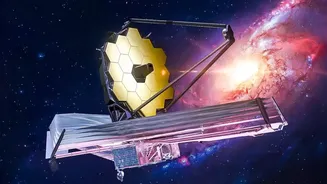
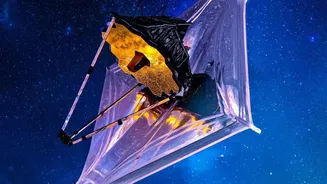
The James Webb Space Telescope is uniquely equipped for this task. Unlike the Hubble Space Telescope, Webb is designed to see the universe in infrared light. This is crucial because many molecules, including water, methane, and carbon dioxide, have their most prominent and clear absorption lines in the infrared part of the spectrum. The telescope uses a suite of highly sensitive instruments, primarily the Near-Infrared Spectrograph (NIRSpec) and the Near-Infrared Imager and Slitless Spectrograph (NIRISS), to capture these faint signals. Together, these tools can gather a complete spectrum, providing a detailed chemical inventory of an alien world's air.
A New Era of Exoplanet Science
Since beginning its mission, JWST has already delivered groundbreaking results. It has provided the most detailed spectrum of an exoplanet atmosphere to date and confirmed water vapour, carbon dioxide, and even signs of photochemistry on worlds hundreds of light-years away. For example, observations of the exoplanet WASP-96 b showed a clear signature of water vapour. In another case, studies of K2-18 b, a potential 'Hycean' (hydrogen and ocean) world, revealed methane and carbon dioxide, strengthening theories that it might have a water ocean. Sometimes the data is complex; for the planet GJ 486 b, scientists detected a water signal but are still working to determine if it comes from the planet's atmosphere or the star itself. These discoveries are transforming exoplanet science from just detection to detailed characterization.