



A Long Journey to an Ocean World
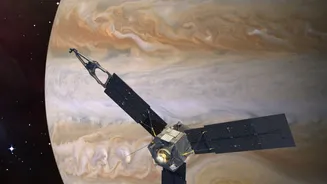
Launched in October 2024, the Europa Clipper is currently on a long and complex trajectory toward the Jupiter system. The spacecraft, the largest NASA has ever built for an interplanetary mission, is not flying directly to the gas giant. Instead, it will
perform a series of gravity assists, using Mars's gravity in 2025 and Earth's in 2026 to build up enough speed for its long flight. The arrival is scheduled for April 2030. Upon reaching its destination, Clipper won’t orbit Europa directly due to Jupiter’s intense radiation fields. It will instead circle Jupiter and perform approximately 49 close flybys of Europa, some as low as 25 kilometers above the surface, to gather its data. This carefully choreographed dance will protect the spacecraft's sensitive electronics while allowing it to study nearly the entire moon.
Why Europa Is So Compelling
For decades, Europa has been a top candidate in the search for habitable worlds beyond Earth. Scientists believe it possesses the three critical ingredients for life as we know it: liquid water, essential chemical elements, and an energy source. Evidence strongly suggests a global saltwater ocean lurks beneath its icy shell, an ocean that may contain more than twice the volume of all of Earth's oceans combined. The necessary chemistry for life is likely present, delivered by asteroid and comet impacts over billions of years. The energy component is more mysterious. With no sunlight penetrating the ice, life couldn't rely on photosynthesis. However, scientists theorize that energy could come from hydrothermal vents on the ocean floor, similar to those on Earth that support rich ecosystems in total darkness.
A High-Tech Toolkit for Exploration
To investigate these questions, Clipper is equipped with a suite of nine powerful science instruments. An ice-penetrating radar will be used to measure the thickness of the ice shell for the first time, giving us a better idea of how isolated the ocean is from the surface. A magnetometer will confirm the ocean's existence and help determine its depth and salinity by measuring the magnetic field generated within the salty water. Other instruments, including high-resolution cameras and spectrometers, will map Europa's chaotic surface geology and analyze its chemical composition. The Thermal Emission Imaging System, or E-THEMIS, will scan the surface for warmer spots, which could indicate areas where the ice shell is thinner or where ocean water has recently erupted.
Hunting for Habitability, Not Aliens
It’s crucial to understand that Europa Clipper is not designed to find life itself. Its main goal is to determine if Europa is habitable—if it has the right conditions that could support life. The mission is an astrobiological reconnaissance, scouting out the moon’s potential. By studying the ice shell, the ocean’s properties, and the surface's chemistry, scientists will be able to build a comprehensive picture of the environment. Finding definitive proof of habitability would be a monumental discovery, guiding future missions that might one day be sent to drill through the ice and explore the ocean directly. Success for Clipper means answering fundamental questions about the nature of this mysterious world, regardless of whether life is there or not.
The Search for Watery Plumes
One of the most exciting possibilities for the mission involves the potential discovery of water plumes erupting from Europa’s surface. Observations from the Hubble Space Telescope and the Galileo probe have suggested that geysers may be venting water from the subsurface into space. If these plumes are active and Clipper can fly through them, its spectrometers could directly sample the material from Europa's interior without ever needing to land. This would provide an unprecedented look at the ocean's composition. However, the evidence for these plumes is not yet definitive, and some recent analyses have cast doubt on earlier findings. Scientists acknowledge that even if they exist, the plumes may be sporadic and difficult to detect, but Clipper will be on the lookout for any signs of current activity.