




A New Way of Seeing
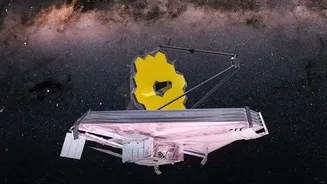
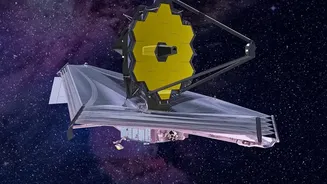
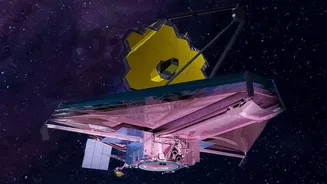
For decades, finding exoplanets—planets orbiting other stars—was the primary goal. Now, the challenge has shifted to understanding them. The James Webb Space Telescope is uniquely equipped for this task. It operates primarily in the infrared spectrum,
which is invisible to the human eye but perfect for cosmic detective work. This allows it to use two powerful techniques. The first, transit spectroscopy, analyzes starlight as it filters through a planet's atmosphere, revealing the chemical fingerprints of gases within. The second, and perhaps more revolutionary for rocky worlds, is measuring a planet's thermal emission. By detecting the faint heat glow from a planet's surface, JWST can take its temperature from light-years away, a feat that was previously impossible for smaller, rocky worlds.
Target: A Scorching Super-Earth
One of the most enigmatic rocky planets in our galaxy is 55 Cancri e, a "super-Earth" located 41 light-years away. It's nearly double the diameter of our own planet but orbits its star in a breathtaking 18 hours. This blistering proximity means its surface is a permanent inferno, with temperatures high enough to maintain a global ocean of molten rock. For years, scientists debated whether a planet so close to its star could hold onto any kind of atmosphere. Most models predicted it would be a bare rock, scoured clean by intense stellar radiation. This made it a perfect test case for JWST's abilities: could it solve the mystery of this lava world?
The Tell-Tale Heat Signature
The first major clue came not from what JWST saw, but from what it didn't see. Based on its orbit, the dayside of 55 Cancri e should have a temperature of around 2,200 degrees Celsius if it were just bare rock. However, when Webb's Mid-Infrared Instrument (MIRI) took the planet's temperature, it registered a significantly cooler 1,500 degrees Celsius. This discrepancy was the smoking gun. A lower-than-expected temperature strongly implies that something is distributing heat from the scorching dayside to the cooler nightside. The most likely culprit? A substantial atmosphere, acting like a blanket to circulate the energy around the planet. This was the best evidence to date for a rocky planet atmosphere outside of our solar system.
An Atmosphere Born from Fire
But how could such an atmosphere exist? The star's intense radiation should have stripped away any primordial gases millions of years ago. The data points to a fascinating solution: a "secondary" atmosphere that is being constantly replenished from the planet itself. Scientists believe the global magma ocean is continuously releasing dissolved gases, a process known as outgassing. This volcanic activity would pump gases like carbon monoxide or carbon dioxide into the air, sustaining the atmosphere against the relentless stellar wind. In essence, 55 Cancri e is a geologically active world where the surface and atmosphere are locked in a dynamic, ongoing relationship, a process that may offer clues into the early histories of planets like Earth and Venus.
The Search Continues
The discovery at 55 Cancri e is a landmark, but it is just one piece of a much larger puzzle. JWST is systematically studying dozens of rocky exoplanets, and the results paint a picture of incredible diversity. For the famous TRAPPIST-1 system, which has seven Earth-sized worlds, the telescope's early observations suggest the innermost planets are likely bare rock with no significant atmosphere. On another planet, GJ 486 b, an initial signal that looked like water vapor was later attributed to spots on the host star, highlighting the immense challenge of this work. Each observation, whether it reveals an atmosphere or confirms its absence, provides crucial data. It helps scientists understand the dividing line between planets that can hold onto their skies and those that cannot.