







The Ground Beneath Their Feet
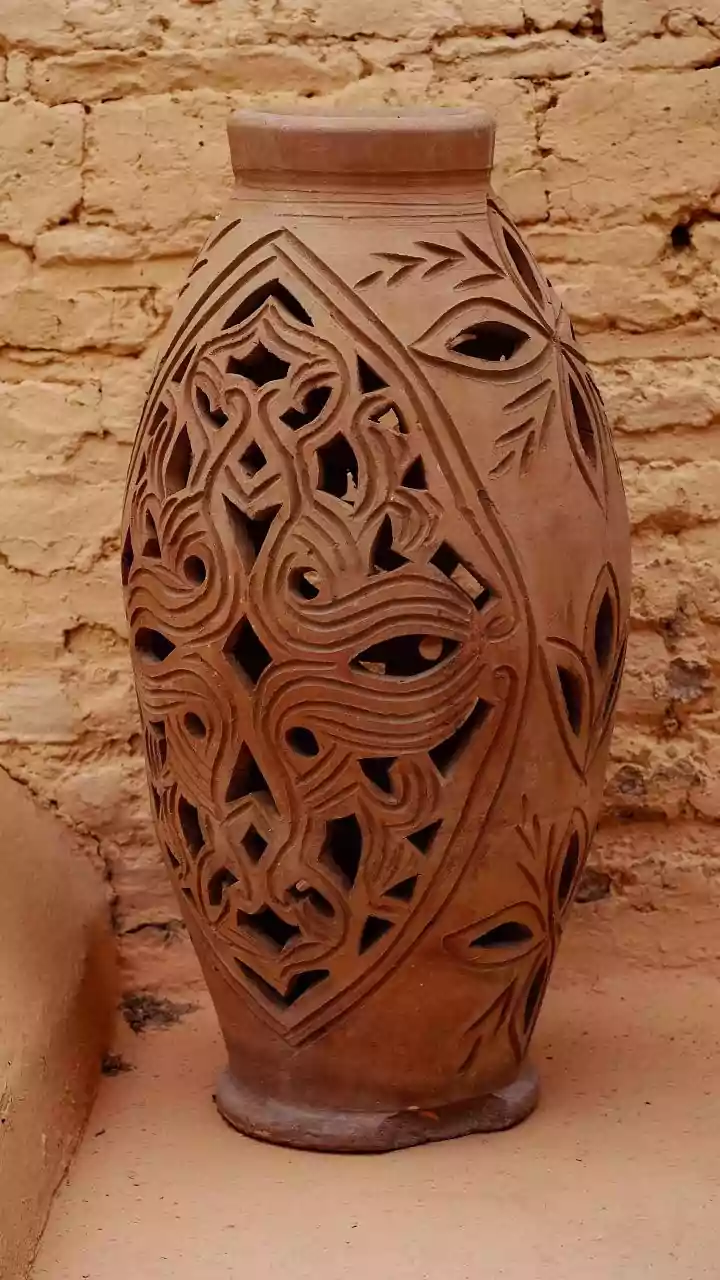
The most fundamental reason for India's diverse pottery traditions is the very earth from which they are formed. The composition of local clay dictates the colour, texture, and durability of the final product. The iron-rich, rust-red soil of West Bengal
gives its terracotta a distinctive warm hue. In contrast, the special clay from the Rann of Kutch, known as 'Rann ki Mitti', is essential for the unique earthenware of Khavda. Even the absence of traditional clay can define a style; Jaipur's famous Blue Pottery isn't made from clay at all, but from a dough of quartz powder, glass, and Fuller's Earth, resulting in its unique, semi-translucent quality. This reliance on local materials is the first chapter in every pot's story.
Technique as Regional Identity
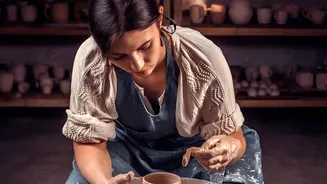
Beyond materials, the techniques passed down through generations of 'Kumhars' (potters) create distinct regional signatures. Consider the black pottery of Nizamabad in Uttar Pradesh. Its mesmerizing black sheen isn't a glaze but the result of a specific firing process. Artisans fire the pots in an enclosed kiln starved of oxygen, a technique known as reduction firing, which turns the clay black. Afterwards, grooves etched into the surface are filled with a silver-coloured powder of zinc and mercury, creating its famous shimmering patterns. This complex, multi-step process, from applying mustard oil for lustre to the final polishing, is a guarded tradition that makes Nizamabad pottery instantly recognizable.
Cultural and Historical Imprints
Pottery is never just functional; it's a canvas for cultural expression and a record of history. The elegant Bankura horse from Panchmura, West Bengal, is a powerful example. These iconic terracotta figures, with their erect necks and alert ears, were originally made for village rituals as offerings to local deities like Dharma Thakur. Though now found in drawing rooms globally as symbols of Indian folk art, their form is deeply rooted in local spiritual belief. Similarly, Jaipur's Blue Pottery carries the legacy of Turko-Persian influence, brought to India by early Turkic rulers and refined under the Mughals. The use of cobalt blue and intricate floral motifs can be traced back to Central Asian tilework, demonstrating how historical conquests and cultural exchanges have shaped regional aesthetics.
Designs That Tell a Story
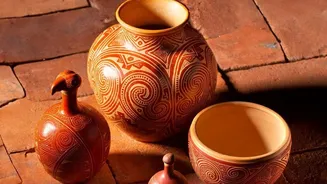
The decorative motifs painted on pottery often serve as a visual language for a community. In the Kutch region of Gujarat, the women of the Kumbhar families are responsible for painting the distinctive designs on Khavda pottery. Using natural black and white pigments on a red ochre (geru) surface, they create geometric patterns and nature-inspired motifs like leaves, waves, and flowers that are specific to their community. This division of labour, where men throw the pots and women decorate them, ensures the preservation of a unique artistic heritage passed from mother to daughter. The style echoes patterns found at the nearby Harappan site of Dholavira, suggesting an artistic lineage thousands of years old.
The Influence of Patronage
Finally, the evolution of many pottery styles was shaped by royal patronage. Khurja, the 'Ceramic City' of Uttar Pradesh, has a history stretching back over 600 years, with some accounts linking its origins to potters who arrived with Afghan king Taimur Lung. However, it was patronage, including from Mughal emperors, that helped establish it as a centre for glazed stoneware. Likewise, the survival of Jaipur Blue Pottery into the modern era is credited to the efforts of rulers like Sawai Ram Singh II, who sent artisans to Delhi to learn the craft in the 19th century, and later revivalists who prevented the art from vanishing in the 1950s. This support elevated certain crafts from village wares to celebrated art forms.