



The Sun's Unseen Power
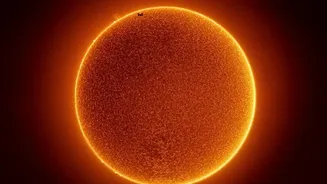
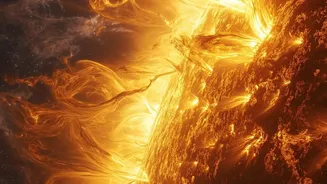
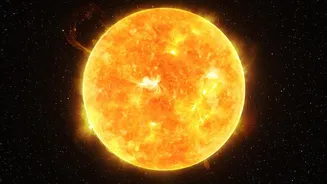
The Sun, the source of all life on Earth, has a volatile side. It constantly sends out a stream of charged particles called the solar wind. But sometimes, it unleashes much more powerful events: solar flares and coronal mass ejections (CMEs). A solar flare is
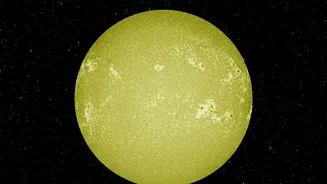
an intense burst of radiation, while a CME is a massive eruption of magnetised plasma from the Sun's outer atmosphere, the corona. When these eruptions are directed at Earth, they can cause significant disruptions to our magnetic field and upper atmosphere, a phenomenon known as a geomagnetic storm. We are currently in Solar Cycle 25, which began in December 2019 and has been more active than initially predicted. Although the peak of sunspot activity may have passed in late 2024, powerful storms can still occur.
Satellites in the Firing Line
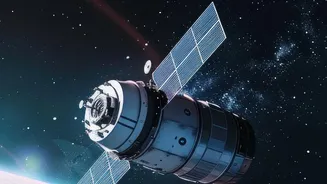
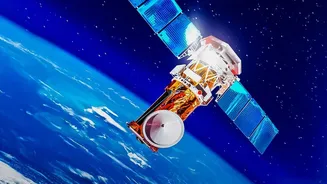
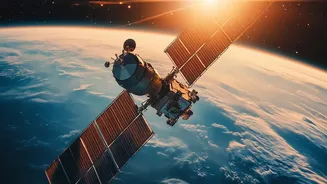
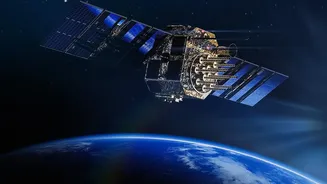
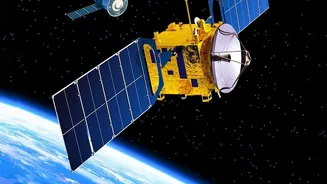
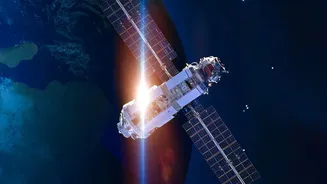
Thousands of satellites orbit Earth, forming the backbone of everything from GPS navigation and telecommunications to weather forecasting. These assets are highly vulnerable to space weather. Energetic particles from solar storms can damage sensitive electronics, degrade solar panels, and shorten a satellite's operational lifespan. The heating of Earth's upper atmosphere during a storm can also increase atmospheric drag, causing satellites in low-Earth orbit to lose altitude and potentially fall out of orbit. This was seen in 2022 when a batch of newly launched Starlink satellites were lost due to a geomagnetic storm. Furthermore, the disruption of the ionosphere can interfere with the radio signals that are essential for both satellite communication and GPS accuracy.
Blackout Risk on the Ground
The impact of a major solar storm isn't limited to space. Geomagnetic storms can induce powerful electrical currents in long conductors on the ground, such as power lines and pipelines. These geomagnetically induced currents (GICs) can flow into power grids, overwhelming transformers and other critical components. At best, this can trip safety systems and cause temporary, regional blackouts. At worst, it can cause permanent damage to high-voltage transformers, which are expensive and can take months or even years to replace, leading to prolonged power outages. This makes the power grid one of the most critical pieces of infrastructure to protect from space weather.
Our Eyes on the Sun
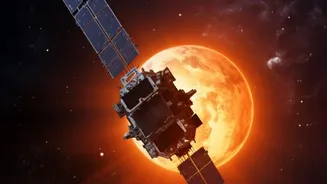
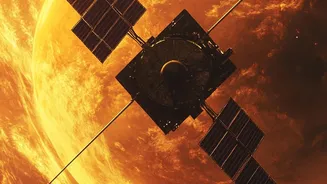
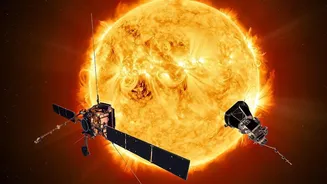
To protect against these threats, scientists rely on a fleet of space-based and ground-based observatories that act as our early warning system. Agencies like the U.S. National Oceanic and Atmospheric Administration (NOAA) and the European Space Agency (ESA) are at the forefront of this effort. Key satellites are positioned at a gravitationally stable point called Lagrange Point 1 (L1), nearly 1.5 million kilometres between the Earth and Sun. From this vantage point, spacecraft like NOAA's new SOLAR-1 (formerly SWFO-L1) and NASA's Advanced Composition Explorer (ACE) can measure the solar wind and spot CMEs heading our way. These satellites give forecasters crucial lead time—from minutes to hours—to issue warnings.
From Warning to Action
When a potentially hazardous solar event is detected, NOAA's Space Weather Prediction Center (SWPC) issues watches, warnings, and alerts, much like the National Weather Service does for terrestrial storms. These alerts allow satellite operators to take protective measures, such as temporarily shutting down non-essential systems or reorienting spacecraft to protect sensitive components. Power grid operators can adjust loads, postpone maintenance, and prepare for potential current surges to maintain stability. Airlines can reroute flights that would normally travel over the poles, where the effects on communication and radiation exposure are strongest. This system of monitoring and mitigation is essential for reducing the potential damage from a major storm.
The Next Generation of Sentinels
As our reliance on technology grows, so does the need for better space weather forecasting. The next generation of monitoring systems is already in development. Launched in 2025, NOAA's SOLAR-1 represents a major upgrade, providing continuous, dedicated operational data and imaging CMEs much faster than previous instruments. Looking ahead, ESA is planning missions like HENON, set to launch in 2027, which will fly even further upstream to provide warnings hours in advance, a dramatic improvement on the current 15-20 minute window for the fastest storms. Future programs like NOAA's Space Weather Next, with its SOLAR-A and SOLAR-B observatories planned for 2029 and 2032, aim to build even more resilience into our monitoring network. These advancements, combined with improved AI modelling, are paving the way for a safer, more prepared future.