




The Importance of a Planetary Shield
An atmosphere is more than just a layer of gas; it's a planet's shield and its engine for potential life. It regulates temperature, blocks harmful radiation, and creates pressure that can allow for liquid water. Without one, a planet is exposed and sterile.
In our quest to find a world like Earth, understanding which planets can hold onto their atmospheres is just as critical as finding planets in the first place. This has become a central question in exoplanet science, pushing astronomers to develop new ways to study these distant worlds in unprecedented detail.
A Star's Destructive Power
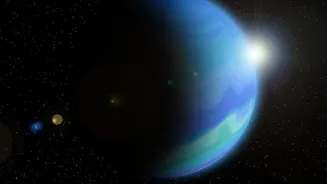
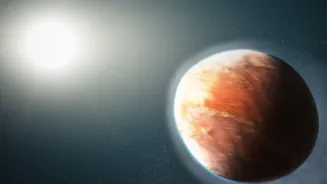
The very star that gives a planet light and warmth can also be its greatest enemy. Stars, especially young and active ones, blast their surroundings with intense high-energy radiation, including X-rays and extreme ultraviolet (XUV) light. This bombardment heats a planet's upper atmosphere, causing the gas to expand and, if the planet's gravity isn't strong enough, escape into space. This process, known as photoevaporation or atmospheric escape, can be so powerful that it strips a gas giant down to its rocky core or renders a smaller, Earth-sized world completely airless. The closer a planet orbits its star, the more intense this onslaught becomes, creating a cosmic battle between stellar radiation and planetary gravity.
How We Watch Atmospheres Disappear
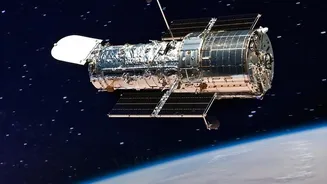
Scientists can't see exoplanet atmospheres directly like a weather map, so they use a clever technique called transit spectroscopy. When an exoplanet passes in front of its star from our point of view (a transit), a tiny amount of starlight filters through the planet's atmosphere. Different gases absorb specific colors, or wavelengths, of light. By analyzing the starlight that reaches our telescopes, astronomers can see which colors are missing and deduce which gases are present in the planet's atmosphere. New instruments, like those on the James Webb Space Telescope (JWST), are so sensitive they can even detect the faint signature of gases like helium as they are actively escaping the planet's gravitational pull, sometimes forming a comet-like tail.
New Insights from the Webb Telescope
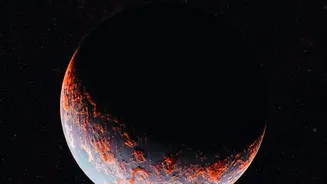
The launch of the James Webb Space Telescope has revolutionized this field, providing a much clearer picture of atmospheric loss. For example, observations of the 'super-puff' planet WASP-107b revealed a colossal cloud of escaping helium stretching nearly ten times the planet's radius. This provided a dramatic, real-time look at how violently a planet's atmosphere can evaporate. In other cases, JWST has found rocky worlds close to their stars that are completely devoid of any significant atmosphere, likely victims of their star's intense radiation. However, some surprising discoveries of lava-covered worlds that have somehow retained or replenished their atmospheres are forcing scientists to rethink their models, suggesting that geological activity, like volcanoes, might play a role in counteracting atmospheric loss.
Redefining the Search for Habitable Worlds
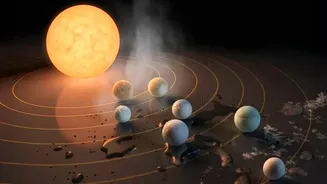
This modern analysis of exoplanet atmospheres is fundamentally changing the search for life. It's no longer enough for a planet to be in the 'habitable zone'—the orbital distance where liquid water could exist. We now know the star's activity is a crucial factor. A planet orbiting a volatile M-dwarf star, the most common type in our galaxy, might be in the right temperature zone but could be so irradiated that it lost its atmosphere billions of years ago. Conversely, recent discoveries of an atmosphere around a rocky planet in its star's habitable zone, LHS 1140b, offer thrilling new hope. By understanding the forces that destroy atmospheres, scientists can better identify the worlds where they might persist, sharpening our focus on the most promising candidates for a truly Earth-like world.