







The Universe's Biggest Mystery
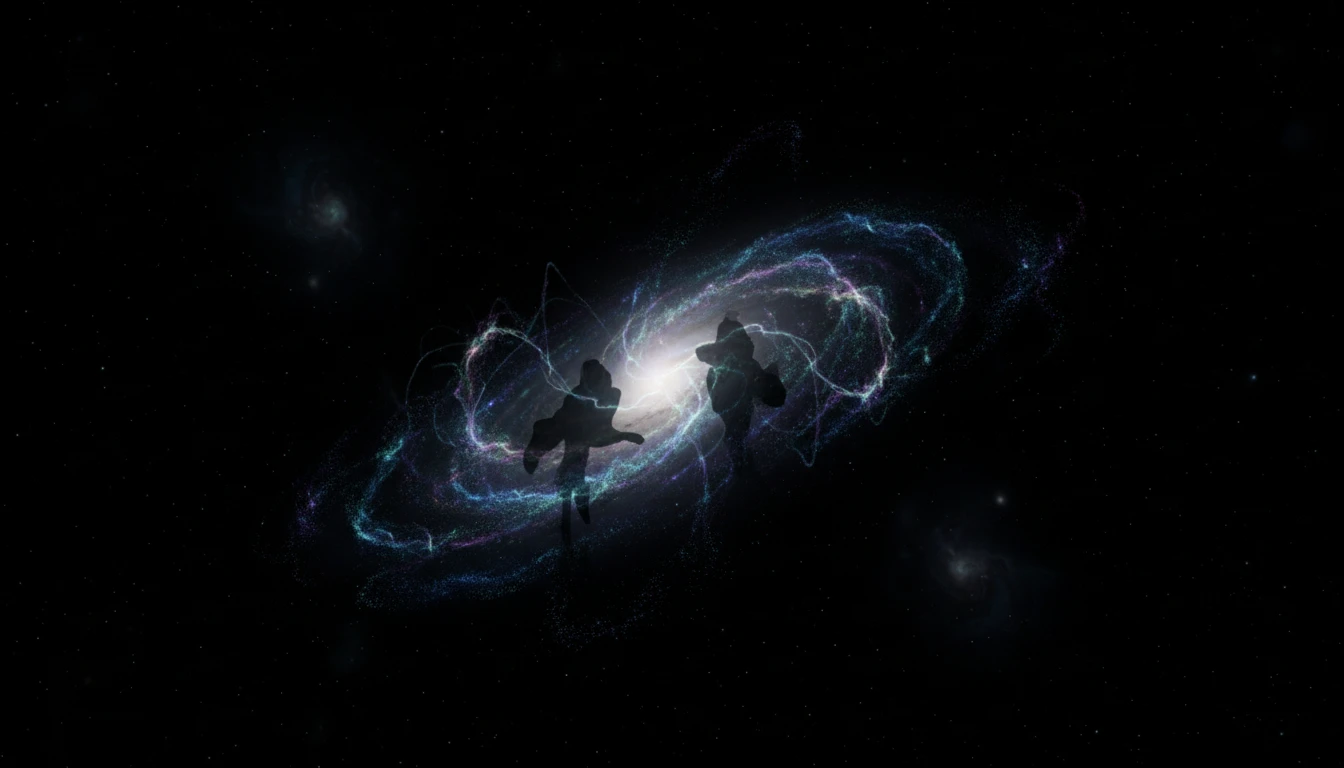
For decades, physicists have been grappling with a cosmic puzzle. Galaxies are spinning so fast that the gravity from their visible stars, gas, and dust isn't nearly enough to hold them together; they should have flown apart long ago. To account for this,
scientists have inferred the existence of 'dark matter', an invisible substance that doesn't absorb, reflect, or emit any light. While its gravitational pull seems to be the cosmic glue holding galaxies together, its true nature remains one of the biggest unanswered questions in modern physics. Most theories propose that dark matter is made of an undiscovered type of particle, but years of searching have turned up nothing, leading some scientists to explore more radical ideas.
A New Dimension of Possibility
Enter the fifth dimension. The idea of extra dimensions isn't new, having been a part of theories trying to unify the forces of nature for over a century. But a recent theory, from physicists at the University of Sheffield, gives it a fresh twist. They propose that dark matter might not be a new particle in our familiar four dimensions (three of space, one of time) at all. Instead, it could be made of particles that exist and move within a hidden, warped fifth dimension. This isn't just a random guess; the theory offers a new way to explain why dark matter has been so stubbornly elusive, suggesting its properties are a direct consequence of the geometry of this hidden dimension.
The 'Resonance' Model
The core of this new model is a concept called 'dark matter resonance'. Imagine striking a tuning fork; it vibrates intensely at a specific frequency. The theory suggests that the geometry of the warped extra dimension naturally 'tunes' the masses of dark matter particles and a hypothetical force-carrier called a 'dark photon'. This creates a resonance, similar to how a musical instrument vibrates strongly when it hits the right note. This is significant because previous models required physicists to artificially fine-tune particle masses to make the numbers work. This new idea suggests the alignment happens naturally because of the dimensional structure itself. This resonance could have made dark matter interactions much stronger in the early universe, which fits with cosmological observations, while explaining why it is so hard to detect today.
Hunting for Fifth-Dimensional Echoes
A theory is only as good as its predictions. The fifth-dimension model offers concrete, testable ideas. One key prediction involves gravitational waves. If this kind of dark matter exists, its interactions could produce a specific background hum of gravitational waves that future, highly sensitive detectors might be able to pick up. Another possibility lies with particle colliders like the Large Hadron Collider (LHC). If dark matter particles are produced in high-energy collisions, they would escape detectors, carrying away energy and momentum. This 'missing energy' signature is something physicists are actively searching for. While these signals could also point to other theories, finding them would provide tantalising clues and give researchers clear new targets in their search.
The Main Caveat: A High-Energy Hurdle
The biggest challenge for this and many other extra-dimensional theories is the immense energy required for experimental verification. The model suggests that the signatures of this fifth dimension would likely appear at very high energy scales, potentially beyond the reach of our current technology, including the LHC. Creating the conditions needed to probe a warped extra dimension or produce its associated particles would require a next-generation collider or a very lucky astronomical observation. Furthermore, the theory is one of many competing to explain dark matter, from modified gravity to other exotic particles. Without direct experimental evidence, it remains a compelling but purely theoretical piece of the puzzle.