

A New Push in Space
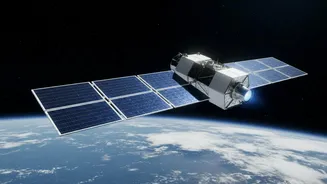
Electric propulsion is a sophisticated technology that uses electrical power, typically generated by a satellite's solar panels, to create thrust. Instead of burning chemical fuel in a powerful burst, it uses electricity to ionize a propellant—usually
an inert gas like xenon—and then accelerates these charged particles with electric or magnetic fields. This creates a gentle but continuous push. While the thrust is much lower than conventional chemical rockets, it is extraordinarily efficient over long periods. This method is ideal for manoeuvres a satellite must perform once it's already in space, such as adjusting its orbit (station-keeping) or moving to its final orbital slot.
Chemical vs. Electric Thrusters
Think of the difference between a drag racer and a fuel-efficient hybrid car. Traditional chemical propulsion is the drag racer: it provides immense thrust quickly, which is essential for launching a rocket from Earth. However, it burns through a massive amount of fuel. Electric propulsion is the hybrid car: it offers very low thrust but has an incredibly high specific impulse—the measure of how efficiently a rocket uses propellant. An electric propulsion system can be six times more fuel-efficient than its chemical counterpart. This means a satellite needs to carry significantly less propellant, which has a cascading effect on its design and capabilities.
The 'More for Less' Advantage
The primary benefit of this incredible fuel efficiency is mass savings. For a typical large communications satellite, the propellant can account for more than half of its total launch weight. By switching to electric propulsion, the fuel requirement can be slashed dramatically. ISRO estimates that for a four-tonne satellite that would normally need about 2.5 tonnes of chemical fuel, an electric system could do the same job with just a few hundred kilograms. This saved mass can be used in two strategic ways: either the satellite can be equipped with more transponders and other payload instruments, increasing its functional capacity, or its operational life can be extended for many more years, as the onboard fuel will last much longer.
ISRO’s Electric Journey
ISRO has been strategically moving towards mastering this technology. While an earlier satellite, GSAT-9, used an imported electric propulsion system for some functions, the agency has since focused on developing its own indigenous systems. A major milestone was the successful long-duration testing of a homegrown Stationary Plasma Thruster, proving its reliability for future missions. This technology is set to be validated on an upcoming Technology Demonstration Satellite (TDS-01) and will feature on next-generation spacecraft like GSAT-N2 (formerly GSAT-20). GSAT-N2 is a powerful high-throughput satellite designed to provide broadband and in-flight connectivity across India, including remote islands. By using electric propulsion, ISRO can ensure such critical satellites serve the nation for their full planned mission life and beyond.