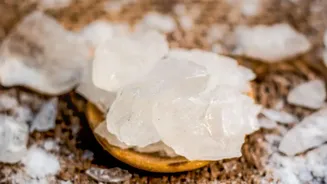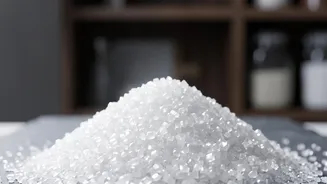






If you picture a salt crystal, you probably imagine a perfect, tiny cube. At a microscopic level, you're right. But a closer look reveals flakes, pyramids, and irregular chunks. So what’s going on? The answer lies in a crystal's journey.
The Default Is a Perfect Cube
At its most fundamental
level, common table salt—or sodium chloride (NaCl)—is built for cubic living. It's made of positively charged sodium ions and negatively charged chloride ions. Thanks to these opposing charges, they attract each other, stacking in a perfectly alternating, repeating three-dimensional grid. This internal structure is called a face-centered cubic lattice. Think of it as a microscopic blueprint that dictates the crystal's shape. Under ideal, stable conditions, as more ions join the party, they follow this blueprint, resulting in the iconic six-sided cube with 90-degree angles that science classes love. This structure is so stable and orderly that it influences not just how the crystal grows, but also how it breaks, often splitting along these same cubic planes.
How the Environment Changes Everything
A crystal's final shape, known as its 'habit', rarely reflects its perfect internal structure because the real world is messy. Factors like temperature, pressure, and especially humidity play a huge role. Humidity is a major disruptor. When the air is humid (above about 75% relative humidity for NaCl), salt crystals can absorb moisture from the air, a process called deliquescence. This can cause the crystal's surface to dissolve slightly into a thin brine. When the air dries out again, the salt recrystallizes. Rapid evaporation tends to create many small crystals, while slower evaporation allows for larger, more well-ordered ones to form. This constant cycle of dissolving and reforming, driven by humidity swings, can dramatically alter a crystal’s size and shape.
The Secret of Pyramids and Flakes
So how do you get a pyramid from a cubic blueprint? This happens when a crystal grows faster at its edges than on its flat faces. This process is common in brines where evaporation happens at the surface under controlled conditions. Instead of stacking neatly layer by layer, the ions rush to join the exposed edges, building them up and out. The faces can't keep up, creating a hollow, stepped shape known as a 'hopper crystal'. Many gourmet flake salts, like Maldon, are famous for these delicate, pyramid-shaped crystals. They are formed by carefully controlling the evaporation of seawater, allowing these hollow pyramids to form on the surface before being harvested by hand. Their fragile, hollow structure is what gives them their signature delicate crunch.
The Role of Impurities
Pure sodium chloride is rare in nature. Most salts, like sea salt or Himalayan pink salt, contain other minerals and trace elements. These 'impurities' get in the way of the orderly stacking of sodium and chloride ions. Depending on the type and amount of impurity, they can either slow down or change the growth pattern on certain crystal faces. For example, the presence of magnesium in sea salt can affect the crystal's final form. Other organic or inorganic compounds present in the water can also act as 'habit modifiers', fundamentally altering the crystal's shape from a simple cube to something more complex. These impurities are also what give different salts their unique colours, like the pink hue of Himalayan salt, which comes from traces of iron oxide and other minerals.