

A Decagon Appears in the South
For decades, scientists have been fascinated by a massive, six-sided jet stream encircling Saturn's north pole, a feature known simply as "the hexagon." It has been a stable, perplexing fixture for over 40 years. Now, the planet's southern hemisphere
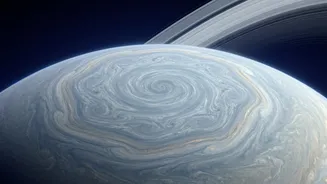
is offering its own geometric puzzle. Recent observations have confirmed the existence of a giant, evolving, 10-sided atmospheric wave—a decagon—around the south pole. This is the first time any large, regular-sided jet pattern has been observed in Saturn's southern hemisphere, providing a counterpart to the famous northern hexagon. The discovery gives scientists a rare opportunity to watch a massive atmospheric pattern develop in near real-time, a process that promises to reveal new secrets about the planet's climate.
The View From Hubble's Legacy
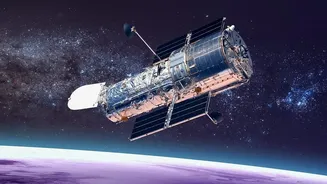
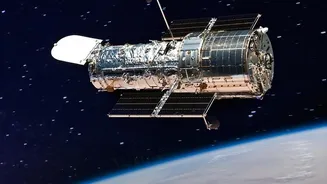
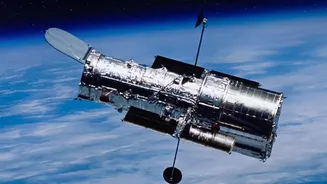
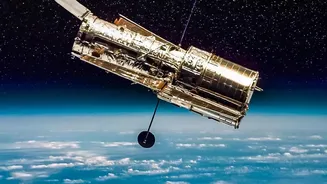
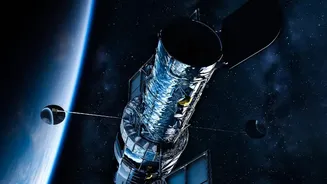
This detailed view was made possible by the Hubble Space Telescope's Outer Planet Atmospheres Legacy (OPAL) program. This long-term project dedicates time each year to capture high-resolution images of our solar system's outer planets, creating a valuable timeline of their atmospheric changes. While hints of a wavy pattern near the southern pole were first noticed by ground-based observatories and amateur astronomers in 2024, it was Hubble's sharp, unobstructed view from space that provided the clear, detailed images needed to confirm the 10-sided structure. Data from Hubble confirmed the feature's presence as far back as 2023, showing it strengthening and becoming more defined over the past few years. This is particularly noteworthy because NASA's Cassini spacecraft, which orbited Saturn from 2004 to 2017, saw no sign of such a formation, indicating it is a very recent development.
A New Kind of Stormy Weather
While it's tempting to call the decagon a southern twin of the northern hexagon, scientists note crucial differences. The northern hexagon has been a remarkably stable feature for decades, while the southern decagon appears to be actively forming and strengthening right now. This suggests they might be distinct atmospheric phenomena. The new wave appears to be a deep, vertically extended structure, not just a pattern on the cloud tops, extending through several layers of Saturn's turbulent atmosphere. Understanding why this pattern is forming now, and why it has 10 sides instead of six, is the next major question for planetary scientists. As Dr. Amy Simon of NASA's Goddard Space Flight Center noted, the most intriguing part is its recent formation, prompting questions as to why it suddenly appeared when nothing like it had been seen before.
Why Planetary Weather Matters
Studying strange weather on other worlds isn't just an astronomical curiosity; it's a natural laboratory for understanding the fundamental physics of atmospheres. The forces that shape these colossal geometric storms on Saturn—a planet with winds reaching 800 kilometres per hour—are extreme versions of the same dynamics that govern weather on Earth. By observing how these patterns form, evolve, and dissipate, scientists can refine their models of fluid dynamics and atmospheric behaviour under conditions impossible to replicate in a lab. This research helps explain not only the climate of gas giants but also offers a comparative framework for understanding the complex weather systems of all planets, including our own. Future observations from both Hubble and the James Webb Space Telescope will be crucial in deciphering what drives the decagon and what it reveals about the inner workings of giant planets.