




The Familiar Sky, An Unfamiliar Truth
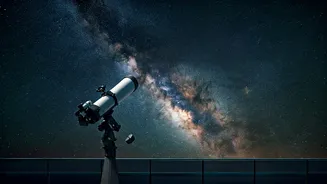
We all do it. After a long day, we step out onto our terrace or balcony, seeking a moment of peace. We look up at the familiar constellations, perhaps tracing the shape of the Saptarishi (the Big Dipper) or searching for the unwavering glow of a planet.
It feels immediate, real-time. But here is the secret that transforms this simple act into something profound: you are not seeing the stars as they are right now. You are seeing them as they were, years, decades, or even centuries ago.
A Telescope Made of Time
This isn't science fiction; it's the beautiful reality of physics. Light, though the fastest thing in the universe, still takes time to travel across the immense distances of space. The distance light travels in one year is called a light-year. So, when we say a star is 100 light-years away, it means the light we see from it tonight began its journey 100 years ago. Every star is a postcard from the past. Your own eyes, without any special equipment, are a time machine. The farther away the star, the further back in time you are looking.
Meeting Stars from Indian History
Let’s make this real. Find a stargazing app on your phone and locate Polaris, the North Star or Dhruva Tara. It's a moderately bright star that has guided travellers for generations. Polaris is approximately 433 light-years away. This means the light hitting your eye tonight left the star around the year 1591. At that time, the Mughal Empire was flourishing under Akbar, and construction on the Charminar in Hyderabad had just begun. You are, in a very real sense, witnessing a photon that started its journey during a completely different era of Indian history.
Now, look for the constellation Orion, easily identifiable by its three-star belt. One of its brightest stars is Betelgeuse, a reddish giant. It is over 640 light-years away. The light you see from Betelgeuse tonight dates back to the 14th century, to the time of the Tughlaq dynasty in the Delhi Sultanate. You are looking at light that is older than the Taj Mahal, older than the voyages of Columbus.
A Universe of Humility and Wonder
Understanding this can fundamentally change your perspective. The small worries and stresses of the day seem to shrink when you are face-to-face with light that has journeyed across space and time, completely indifferent to human affairs. It’s a humbling experience. The stars connect us to a timeline far grander than our own. That faint flicker of light has travelled for centuries, through the vacuum of space, past nebulae and dust clouds, just to end its journey in your eye as you stand on your terrace.
This perspective doesn’t require a PhD in astrophysics or an expensive telescope. It just requires a moment of quiet contemplation. It’s a reminder that we are part of a vast, ancient, and interconnected cosmos. The light from a star that ‘died’ centuries ago could still be reaching us tonight, a ghostly echo from a celestial giant.
How to Become a Time Traveller Tonight
You don’t need any special gear to begin your journey through time. Find the darkest spot you can, perhaps on your building’s roof or a quiet corner of your balcony. Let your eyes adjust to the darkness for about 15-20 minutes; this will dramatically increase the number of stars you can see. Use a free stargazing app like Stellarium or SkyView Lite to help you identify a few bright stars like Polaris, Sirius, or Vega. Look up their distances. In that moment, you're not just looking at a dot of light; you're connecting with a piece of the distant past. You are a witness to history, written in starlight.