




The Fiery Problem of Re-Entry
One of the greatest challenges in space exploration is not rocketing away from Earth, but coming back—or arriving at another planet. When a spacecraft enters an atmosphere, it travels at incredible speeds, sometimes over 28,000 kilometres per hour. This
causes the air in front of it to compress, generating extreme heat that can reach thousands of degrees. For decades, engineers have relied on rigid, ablative heat shields—like those on the Apollo capsules—or thermal tiles like those used on the Space Shuttle. These work, but they have a critical limitation: their size is constrained by the diameter of the rocket fairing they launch in. This size constraint limits the mass of the payload they can protect, creating a major roadblock for ambitious missions, such as landing heavy cargo or human habitats on Mars.
A Revolutionary Solution: The Inflatable Aeroshell
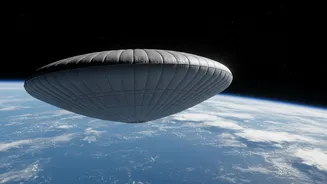
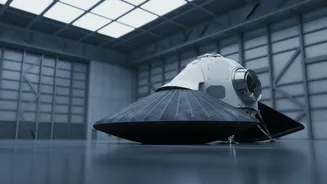
Enter the Hypersonic Inflatable Aerodynamic Decelerator, or HIAD. Instead of a fixed, rigid shield, this technology is a lightweight, inflatable structure that can be packed into a small volume for launch. Once in space, just before atmospheric entry, it inflates to a diameter much larger than any rigid shield could be. This larger surface area acts like a giant brake, creating significantly more drag to slow the spacecraft down more effectively. A bigger shield catches more of the sparse molecules in a thin atmosphere like Mars', providing better deceleration. The concept promises to be a game-changer, enabling missions previously thought impossible due to the constraints of traditional heat shields.
Advanced Materials and Smart Design
So, how does a 'balloon' survive re-entry temperatures that can vaporise metal? The answer lies in cutting-edge materials. The outer layer of the inflatable shield is a flexible thermal protection system made from a woven ceramic fabric, often silicon carbide. This material can be woven into a cloth but is capable of withstanding temperatures up to 1,600 degrees Celsius. Beneath this outer skin are layers of high-tech insulation that prevent the intense heat from reaching the inflatable structure itself. The structure is composed of stacked rings, or tori, woven from synthetic polymers that are stronger than steel by weight. These rings are inflated with gas, providing the rigid shape needed to withstand the immense aerodynamic forces during re-entry.
Proof of Concept: The LOFTID Mission
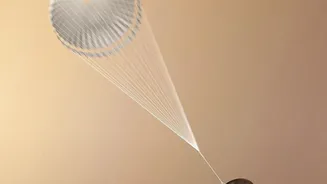
This technology is not just theoretical. In November 2022, NASA successfully demonstrated it with the Low-Earth Orbit Flight Test of an Inflatable Decelerator (LOFTID) mission. Launched as a secondary payload, the 6-meter diameter heat shield inflated in orbit and successfully re-entered Earth's atmosphere at nearly Mach 29. It survived the intense heat and dynamic pressure, slowing from over 28,000 km/h to less than 130 km/h before deploying a parachute for a gentle splashdown in the Pacific Ocean. The mission was declared a huge success, proving that the inflatable aeroshell design is a viable and robust technology ready for future application. The data gathered is now crucial for designing even larger shields for future planetary missions.
Unlocking the Future of Exploration
The success of inflatable heat shields opens a new chapter in space exploration. The primary advantage is the ability to land much heavier and larger payloads on planets with atmospheres. For Mars, this means we could potentially land entire habitats, large rovers, and the ascent vehicles needed to bring astronauts home. It could also enable missions to destinations with thick atmospheres like Venus or Saturn's moon Titan, where deceleration is even more challenging. Beyond planetary exploration, the technology has commercial applications, such as affordably returning rocket stages or in-space manufactured goods to Earth. By solving one of the most difficult physics problems of spaceflight, inflatable heat shields are paving the way for bolder, more ambitious exploration of our solar system.