






An Ocean World of Mystery
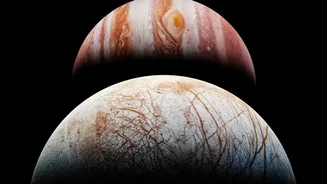
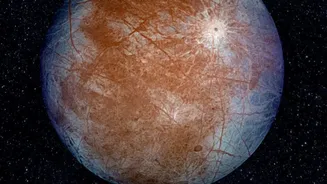
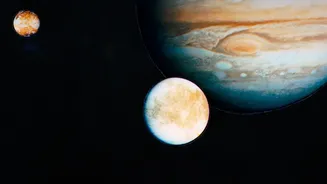
Europa has long captivated scientists. Smaller than Earth's Moon, it shows compelling evidence of a global ocean buried beneath a thick shell of ice. This ocean is estimated to contain more than twice the amount of water in all of Earth's oceans combined,
making it one of the most promising places in our solar system to search for the ingredients of life. The fundamental question is whether this alien sea could be habitable. To answer that, scientists need to understand its properties: How thick is the ice? How deep and salty is the water? And is there any exchange between the surface and the ocean below? Answering these requires a dedicated observer.
A Clever Path Through Danger
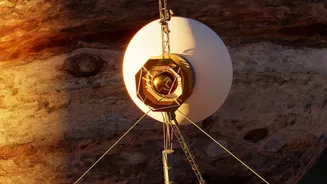
Getting close to Europa is fraught with peril. The moon is located deep within Jupiter's powerful magnetic field, which traps and accelerates particles to create intense radiation belts that would destroy an unshielded spacecraft. Instead of orbiting Europa directly, the Europa Clipper will orbit Jupiter in a long, looping path. This clever trajectory will allow the spacecraft to perform dozens of close flybys of Europa—some as low as 25 kilometers from the surface—while minimising its time in the most intense radiation zones. Launched in October 2024, the spacecraft is currently on a multi-year journey, having already performed a gravity assist at Mars in February 2025 and heading for another at Earth in December 2026 before arriving at the Jupiter system in April 2030.
Seeing with Radar and Magnetism
To probe a hidden ocean, the Clipper carries a powerful suite of nine science instruments, but two are key to understanding the ocean's dynamics. The first is a sophisticated ice-penetrating radar called REASON (Radar for Europa Assessment and Sounding: Ocean to Near-surface). This instrument will bounce radio waves through the ice shell, seeking to measure its thickness and locate the boundary where ice meets liquid water. It might even detect pockets of water trapped within the shell. The second is a sensitive magnetometer, ICEMAG. As Jupiter's powerful magnetic field sweeps past Europa, it should induce a secondary magnetic field in the moon's salty, conductive ocean. By measuring this induced field, scientists can confirm the ocean's existence and estimate its depth and salinity without ever touching it.
Searching for Signs of Activity
The dynamics of Europa's ocean aren't just about its static properties, but also about how it interacts with the world above and below. The mission will search for evidence of activity, such as plumes of water vapor that might erupt from the surface. A thermal imager, E-THEMIS, will scan the icy crust for warm spots that could signal recent water eruptions. Meanwhile, a mass spectrometer called MASPEX will be ready to analyze the chemical composition of any gases or particles the spacecraft flies through, sniffing for traces of ocean material vented into space. These instruments work together to build a complete picture of Europa, from its deep interior to its tenuous atmosphere, to assess its potential for harbouring life.