


How Microwaves Actually Work
First, let's clear up a common myth: microwaves don't cook food from the inside out. Instead, they flood the oven's interior with electromagnetic waves. These waves cause certain molecules within the food—primarily water—to vibrate billions of times per
second. Think of it like microscopic friction. This rapid vibration generates heat, which then cooks the food. This is why foods with high water content, like vegetables or soups, tend to heat up very quickly. The energy is absorbed by the food and converted directly into heat, a process known as dielectric heating.
The Problem of Standing Waves
The metal walls of a microwave are designed to reflect the waves, bouncing them around the interior until they are absorbed by your food. As these waves travel and reflect, they interfere with each other, creating a complex energy pattern. This interference leads to the formation of "standing waves"—fixed areas where the wave energy is either very strong (antinodes) or very weak, even zero (nodes). These become the hot and cold spots in your oven. If a part of your food sits in a node, it receives very little energy and remains cold. If it sits in an antinode, it gets blasted with energy and can overcook.
The Role of the Turntable
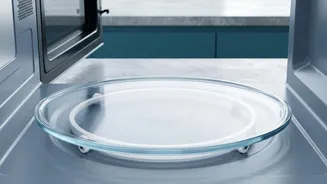
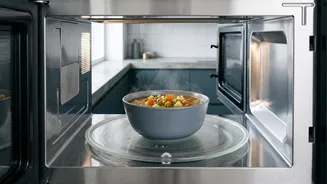
This is precisely why most microwaves have a rotating turntable. Its job is to move your food through these different energy zones. As the plate rotates, every part of the dish is meant to pass through both the hot spots and cold spots, averaging out the energy exposure for more even cooking. While it’s a clever solution, it’s not perfect. The circular motion can still leave the very centre of the plate relatively stationary, which is why the middle of a dish is often the last part to get warm. Some newer or commercial models use a "mode stirrer," a metal fan that scatters the waves to achieve a similar effect without a turntable.
Why Your Food Is Also to Blame
The oven's wave pattern is only half the story. The food itself plays a huge role in how evenly it heats. Microwaves can only penetrate so far into food—typically just over a centimetre. For thicker items, the outer layers are heated directly by the waves, while the inside relies on heat conducting inward from the surface, much like in a conventional oven. This is why a dense potato can be hot on the outside but cool in the core. Furthermore, different ingredients absorb energy at different rates. A lasagna, for instance, has watery sauce (heats fast), dry pasta (heats slow), and fatty cheese, all of which react differently to the microwaves, creating a complex temperature map.
Tips for Perfectly Even Heating
Armed with this knowledge, you can outsmart your microwave. Instead of piling food in the centre, arrange it in a ring shape on the plate, leaving a space in the middle. This allows the waves to hit the food more evenly from all sides. For dense or irregularly shaped items, cut them into smaller, uniform pieces. Covering your food with a microwave-safe lid or even a damp paper towel traps steam, which helps distribute heat and keep the food moist. Most importantly, embrace the pause. Stop the microwave halfway through, give your food a good stir or rotate the dish, and then continue heating. Finally, let your food stand for a minute or two after the timer goes off. This allows the heat to continue to spread from the hotter parts to the colder parts, resulting in a much more uniformly warm meal.