

The Foundation: The Banana Leaf & Rice
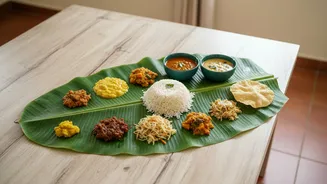
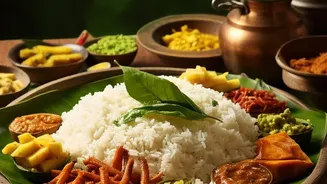
Before any food arrives, a fresh banana leaf is laid with its narrow end pointing left. This isn't just for presentation; when warm food is placed on it, the leaf releases beneficial compounds and a subtle aroma. Soon, a mound of 'choru' or rice, typically
the reddish-brown and nutty Kerala Matta rice, is served on the lower half. This rice is the canvas for the culinary masterpiece to come, representing prosperity and the harvest's bounty. All other dishes are arranged around it, with the upper half reserved for accompaniments and the lower half for rice and its main curries.
The Opening Act: Pickles and Chips
The feast begins with items on the top left of the leaf. You'll find a pinch of salt, followed by crispy snacks. These include 'upperi' (banana chips) and 'sharkara varatti' (banana chips coated in jaggery), offering a delightful crunch. Alongside them are an assortment of 'achars' or pickles. Key among them is 'inji puli' or 'puli inji', a sweet, sour, and spicy chutney made from ginger, tamarind, and jaggery. It’s a flavour bomb designed to awaken the palate and aid digestion. You will also find tangy mango and lime pickles.
The Side Dishes: A Medley of Vegetables
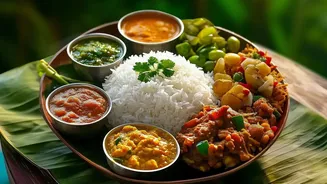
Next come the wonderful array of vegetable side dishes, each with a unique flavour profile. 'Thoran' is a dry stir-fry of finely chopped vegetables like cabbage or beans with grated coconut. 'Avial' is perhaps the most iconic Sadhya dish, a thick mixture of various vegetables cooked in a coconut and yoghurt gravy. It symbolizes unity and abundance. You’ll also find 'Kichadi' and 'Pachadi', which are yoghurt-based dishes; Kichadi is often made with cucumber or beetroot and is mildly sour, while Pachadi, often made with pineapple, is sweeter. 'Olan' is a very mild and subtle curry made from ash gourd and cowpeas in coconut milk, designed to cleanse the palate.
The Main Event: The Curries
Now for the 'ozhichu curries' (curries that are poured). The first course served over the rice is 'parippu', a simple but comforting curry made of moong dal, usually served with a spoonful of ghee. After you finish this portion, 'sambar' is served. This hearty and tangy stew of lentils and vegetables is a staple across South India and represents the diversity of Kerala's produce. 'Rasam', a thin, peppery, and tamarind-based soup, often follows, known for its digestive properties. You might also encounter 'pulissery' or 'kalan', rich and tangy yoghurt-based curries.
The Unmissable Extra: Pappadam
Served on the side, but essential to the experience, is the 'pappadam'. This crispy, fluffy cracker made from lentil flour is best enjoyed by crushing it over your rice and curry. It adds a satisfying crunch and a salty counterpoint to every bite, whether you're eating the initial parippu course or the rich sambar. Don't be shy about asking for an extra one; it’s a universal favourite.
The Sweet Finale: Payasam
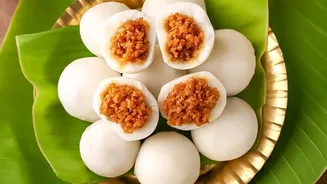
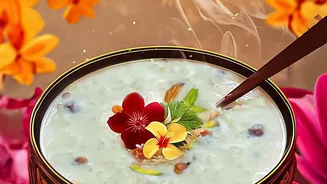
No Sadhya is complete without 'payasam', the dessert. Often, more than one type is served. A classic is 'Ada Pradhaman', made with rice flakes, jaggery, and coconut milk. Another is 'Palada Payasam', which is similar but uses milk and sugar. You might also find 'Parippu Payasam', made from lentils. Traditionally, a small banana is served alongside the payasam. The custom is to mash the banana into the payasam on the leaf, creating a uniquely delicious final course.