




A New Eye on the Cosmos
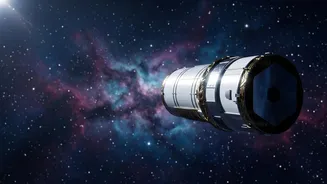
On August 30, 2026, a SpaceX Falcon Heavy rocket thundered into the Florida sky, carrying NASA's next great observatory. The Nancy Grace Roman Space Telescope, named after NASA's first chief of astronomy, is now on a three-month journey to a stable orbit
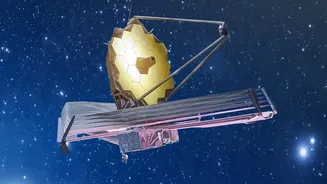
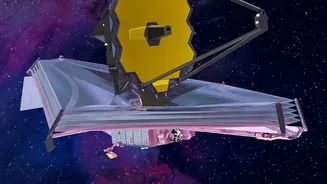
about 1.5 million kilometers from Earth. This location, known as the second Lagrange point (L2), is the same region where the James Webb Space Telescope (JWST) operates, offering a cold, clear view of the cosmos far from Earth's interference. The launch marks the beginning of a five-year primary mission that will tackle some of the biggest questions in astronomy. With its powerful instruments now being commissioned, scientists are preparing for a flood of data that could reshape our cosmic map. First images are expected in early 2027.
The Power of the Wide-Angle View
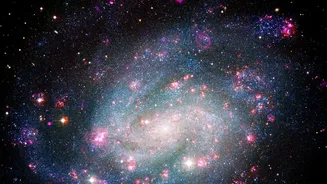
Roman's primary strength is its incredible field of view. While its main mirror is the same size as the Hubble Space Telescope's at 2.4 meters, its advanced optical design allows it to see a patch of sky at least 100 times larger than Hubble can in a single snapshot. Think of it as a wide-angle lens for the cosmos, while Hubble and Webb are more like zoom lenses. This capability will allow Roman to survey huge swaths of the universe with unprecedented speed and efficiency. In its five-year mission, it is expected to map an area 50 times larger than Hubble has in over 30 years. Its 300-megapixel Wide Field Instrument will generate vast, panoramic images, helping astronomers understand the large-scale structure of the universe.
Hunting for Dark Energy
One of Roman's primary goals is to investigate one of the most profound mysteries in physics: dark energy. This mysterious force is thought to be responsible for the accelerating expansion of the universe. Roman will tackle this question by conducting enormous surveys of over a billion galaxies. By mapping their distribution and measuring how fast they are moving away from us at different cosmic eras, scientists can trace the expansion history of the universe. It will also hunt for thousands of Type Ia supernovae—a specific kind of exploding star that serves as a 'standard candle' to measure cosmic distances with great precision. These measurements will test whether dark energy is a constant force or if it has changed over time, a finding that could overturn the standard model of cosmology.
A Census of Alien Worlds
Roman is also set to become a prolific planet-hunting machine. While it will use the transit method that missions like Kepler made famous, its main technique will be gravitational microlensing. This method, predicted by Einstein's theory of general relativity, occurs when a foreground star and its planets pass in front of a more distant star. The foreground star's gravity acts as a lens, magnifying the light from the background star. A planet orbiting the lens star creates an additional, brief spike in brightness. This technique is especially good at finding planets that are farther from their star, in orbits similar to those of Earth or Jupiter, and even 'rogue' planets that don't orbit a star at all. Astronomers expect Roman will find thousands of new exoplanets, creating the most complete census of planetary systems to date.
A Partner to Hubble and Webb
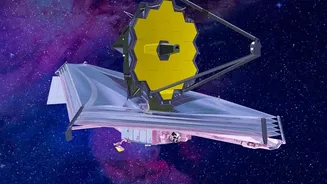
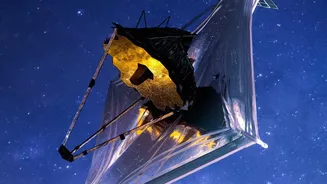
Roman is not a replacement for Hubble or Webb, but a powerful partner that complements their capabilities. Roman will act as a cosmic scout, identifying intriguing targets across vast regions of the sky. The James Webb Space Telescope, with its incredible sensitivity and deep-infrared 'zoom' capabilities, can then perform detailed follow-up studies of the most promising objects Roman finds. Meanwhile, Hubble will continue to provide crucial high-resolution observations in visible and ultraviolet light. Together, the three observatories will provide a more complete picture of the universe, from the grandest cosmic structures down to the fine details of distant galaxies and the atmospheres of alien worlds.