




A New Eye on the Cosmos
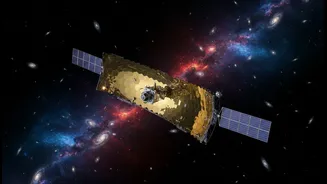
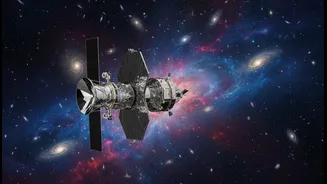
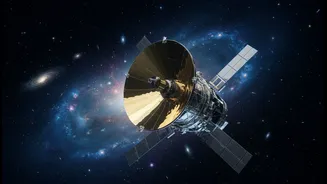
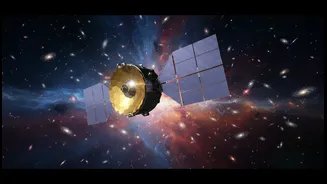
Scheduled for launch by August 2026, the Nancy Grace Roman Space Telescope is NASA's next great observatory, poised to tackle some of the biggest questions in astrophysics. Named after NASA's first chief of astronomy, this flagship mission is designed
for discovery on an epic scale. At its heart is a 2.4-meter primary mirror, the same size as the Hubble Space Telescope's, but that's where the similarities start to diverge. Roman is engineered not just to see, but to survey. Its primary goal is to conduct wide-field infrared surveys with unprecedented speed and efficiency, gathering data that will fuel astronomical research for decades to come. The telescope will journey to the second Sun-Earth Lagrange point (L2), a stable gravitational location about one million miles from Earth, which allows for an unobstructed and continuous view of the universe.
Seeing the Bigger Picture
Roman’s superpower is its incredible field of view. Its main camera, the Wide Field Instrument (WFI), will capture a patch of the sky at least 100 times larger than Hubble's infrared camera can in a single snapshot, all while maintaining the same sharp, high-resolution quality. Think of it like this: where Hubble might capture a stunning portrait of a single galaxy, Roman will capture a panoramic group photo of thousands. This ability to image vast cosmic areas quickly is what truly sets it apart. Over its five-year primary mission, Roman is expected to photograph more than 50 times the amount of sky that Hubble has covered in over 30 years. This survey speed will allow it to build enormous cosmic maps, moving beyond individual targets to chart the very structure and fabric of the universe across immense distances.
Chasing the Universe's Dark Side
A primary target for Roman's mapping mission is the universe's mysterious dark side. Roughly 95% of the cosmos is made of dark energy and dark matter, elusive components that we can only detect through their gravitational effects on the matter we can see. Roman will tackle the mystery of dark energy—the force thought to be driving the accelerating expansion of the universe—using three distinct methods: observing distant supernovae, mapping the distribution of galaxies (known as baryon acoustic oscillations), and studying weak gravitational lensing. By precisely measuring how the universe's expansion has changed over 10 billion years, scientists hope to understand if dark energy is a constant force or something that has evolved over time. The telescope's High-Latitude Wide-Area Survey will analyze the light from hundreds of millions of galaxies, tracing the distorted web of dark matter and providing a 3D map of its distribution.
A Galactic Planet Census
Beyond cosmology, Roman is set to revolutionize the hunt for exoplanets. While the Kepler and TESS missions have found thousands of planets using the 'transit' method (watching for a star's light to dim), Roman will primarily use a different technique called gravitational microlensing. This method relies on a trick of general relativity: when a star and its planet pass in front of a more distant star, their combined gravity acts like a lens, briefly magnifying the background starlight. This technique is sensitive enough to find planets much farther from their stars and even rogue planets that roam the galaxy untethered to any star. Through its Galactic Bulge Time-Domain Survey, Roman will monitor hundreds of millions of stars toward the crowded center of the Milky Way, expecting to discover over a thousand planets via microlensing. It will also detect an estimated 100,000 planets using the transit method, potentially increasing the number of known exoplanets by an order of magnitude in a single mission.