






How Microwaves Actually Work
Inside every microwave oven is a device called a magnetron, which generates invisible waves of electromagnetic energy—microwaves. These waves are channelled into the cooking chamber, a metal box designed to reflect them. Contrary to popular belief, microwaves don't
cook food from 'inside out'. Instead, they primarily heat using a process called dielectric heating. They are particularly good at energising certain molecules, most notably water.
It's All About Shaking Water Molecules
Food contains a lot of water, as well as fats and sugars. The microwaves cause these polar molecules to rapidly flip back and forth, trying to align with the oscillating electric field. This rapid vibration creates friction between the molecules, which in turn generates heat. Think of it like rubbing your hands together to warm them up, but happening millions of times per second on a microscopic level. Because water is so responsive to this process, foods with higher moisture content tend to heat up much more quickly than drier foods. This also explains why ice, with its rigidly structured molecules, heats much less efficiently than liquid water.
The Real Culprit: Standing Waves
So, if the microwaves are bouncing all around, why isn't the heating perfectly even? The answer lies in a phenomenon called 'standing waves'. As the microwaves reflect off the metal walls of the oven, they interfere with each other. This creates a fixed pattern of high-energy spots (antinodes) and zero-energy spots (nodes) inside the oven. If a part of your food happens to sit in a node, it will receive almost no energy and remain cold, while a section sitting in an antinode will get blasted with energy and become extremely hot. These hot and cold spots can be just a few centimetres apart, leading directly to that unevenly heated plate of food.
Why Your Food Takes a Spin
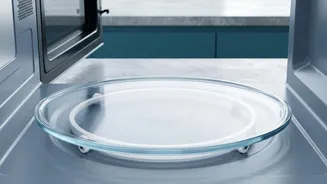
This is precisely why most microwave ovens have a rotating turntable. The purpose of the spin is not aesthetic; it's a simple but brilliant mechanical solution to the problem of standing waves. By constantly moving the food through the entire pattern of hot and cold spots, the turntable ensures that every part of your meal gets a more uniform dose of microwave energy. Studies have shown that rotating the food can improve heating uniformity by as much as 40 percent. Without the rotation, you would be left with the same hot and cold patches every time.
Tips for Perfectly Even Heating
Understanding the science allows you to outsmart your microwave for better results. First, arrange your food in a ring or doughnut shape on the plate, leaving the centre empty. This helps the microwaves penetrate more evenly. Since the turntable's centre moves the least, placing food on the edge of the plate ensures it travels a greater distance through the heating zones, further improving evenness. For dishes like pasta or rice, adding a splash of water and covering the plate with a damp paper towel can help restore moisture and prevent drying out. Finally, always remember to stir your food halfway through the cooking time. This manually redistributes the heat and is especially crucial for soups, stews, and casseroles.