




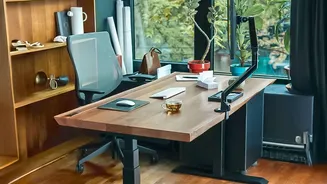

Start From the Ground Up
The foundation of good posture starts with your feet. Your chair height should allow both of your feet to rest flat on the floor. If your feet are dangling, even slightly, your pelvis can tilt backward, which flattens the natural curve of your lower spine
and increases pressure on your discs. Your thighs should be roughly parallel to the floor, with your knees positioned at or just slightly lower than your hips. If your desk is high and you need to raise your chair to compensate, use a footrest to ensure your feet remain firmly supported. Once your feet and legs are set, you have the stable base needed to adjust everything else.
Dial In Your Lumbar Support
Your lower spine has a natural inward curve, and your chair should support it. Sit back fully so your hips are touching the back of the chair. Adjust the chair's lumbar support so it fits snugly into the curve of your lower back, roughly at your belt line. You should feel supported, not pushed forward. If your chair lacks adjustable lumbar support, a rolled-up towel or a small cushion can work as a substitute. Failing to support this curve forces your back muscles to work overtime to hold you upright, leading to fatigue and pain.
Set Your Seat Depth and Armrests
With your back against the backrest, check the space between the front edge of the seat and the back of your knees. There should be a gap of about two to three fingers' width. This prevents the seat from cutting off circulation or pressing on nerves. Next, adjust your armrests. They should be at a height that allows your shoulders to remain relaxed, not hunched or shrugged. Your elbows should be bent at approximately a 90-degree angle and stay close to your body. The armrests are there to provide gentle support, not to carry your weight.
Position Your Monitor Correctly
Improper monitor placement is a major cause of neck and upper back strain, which can cascade down to your lower back. Position your monitor directly in front of you, about an arm's length away. The top of the screen should be at or just slightly below your eye level. This encourages a neutral neck position where you look slightly downward toward the center of the screen, rather than craning your neck up or hunching forward. If you use a laptop, propping it up on a stand or a stack of books and using a separate keyboard and mouse is essential to achieve this correct height.
Align Your Keyboard and Mouse
Your desk setup should allow you to work without unnecessary reaching or twisting. Place your keyboard directly in front of you at a height that maintains that 90-degree bend in your elbows, with your wrists straight and in a neutral position while typing. The mouse should be right next to the keyboard, close enough that you don't have to stretch to reach it. Keeping your most-used items within an easy reach zone minimizes the small, repetitive movements that can lead to strain over the course of a day.
Remember to Move
Even the most perfectly ergonomic setup cannot undo the strain of remaining in a static position for hours. Your body is designed for movement. The best posture is your next posture. Aim to stand up, stretch, and walk around for a few minutes every 30 to 60 minutes. These short breaks improve blood flow, reduce muscle stiffness, and give your body a much-needed reset. Set a timer to remind yourself if you tend to get lost in your work. This simple habit is just as important as the initial setup for preventing back pain.