






A Tale of Two Planets
Venus and Earth are similar in size, mass, and composition, suggesting they had a similar start in the solar system. Yet, today, they could not be more different. Earth is a haven for life, while Venus has a crushing carbon dioxide atmosphere and surface
temperatures hot enough to melt lead. This divergence is one of planetary science's greatest mysteries. Understanding why Venus took such a dramatically different evolutionary path is crucial, as it provides a natural laboratory for studying how planetary climates can change, offering potential insights into our own planet's future. Scientists have long theorised that Venus may have once had oceans, but a runaway greenhouse effect boiled them away.
The Sulfur Dioxide Puzzle
A significant piece of the puzzle is sulfur dioxide (SO₂), a pungent gas that on Earth is primarily associated with volcanic eruptions. On Venus, SO₂ is the third-most-abundant gas in the atmosphere and a key ingredient in its thick, sulfuric acid clouds. Here's the catch: SO₂ should be short-lived in Venus's upper atmosphere. Intense solar radiation should break the molecules apart quickly. Its persistent presence, therefore, implies it's being constantly replenished from a source below. This makes SO₂ a tantalising chemical fingerprint, pointing towards a dynamic and active planet.
Mapping a Volcanic Fingerprint
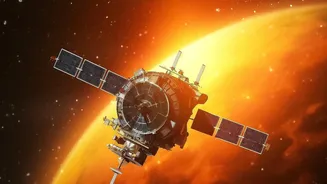
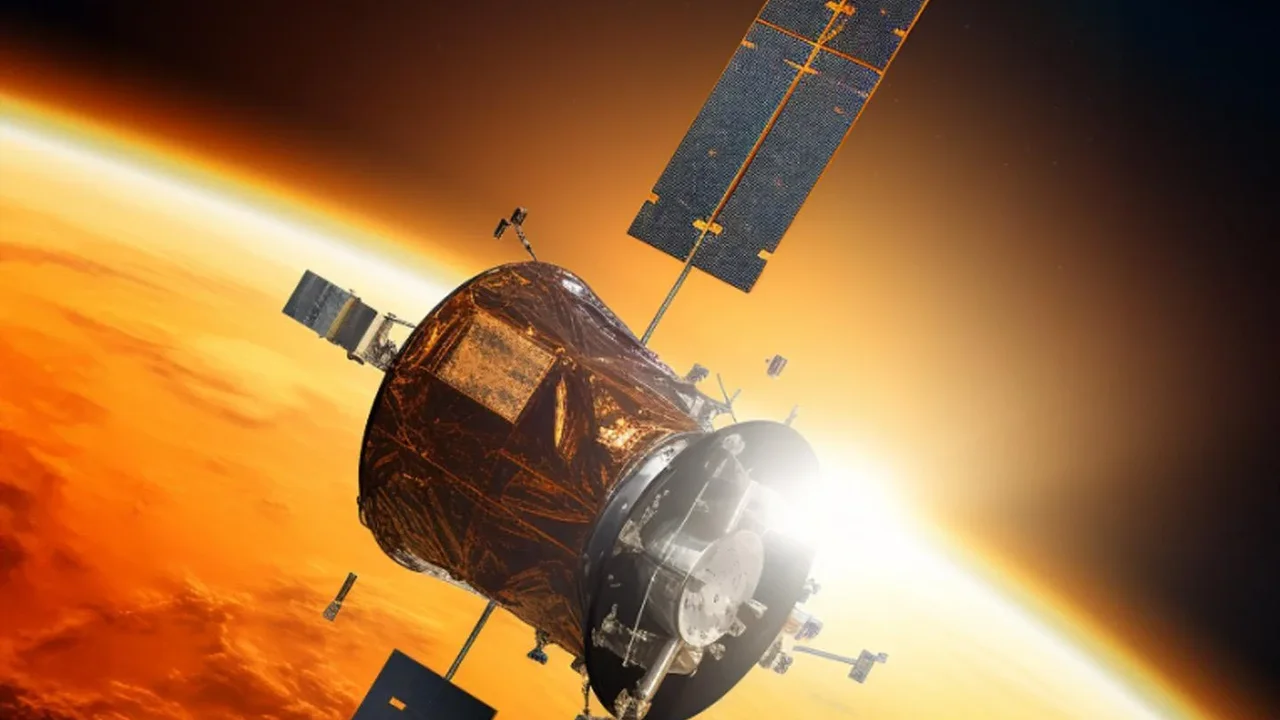
To understand this replenishment, scientists use various spacecraft and telescopes to map SO₂ concentrations across the planet. Missions like Europe's Venus Express and Japan's Akatsuki orbiter have been instrumental. These spacecraft use specialised cameras and spectrometers that can observe Venus at ultraviolet and infrared wavelengths, allowing them to peer through the thick cloud deck to a certain degree. By analysing how light is absorbed by the atmosphere, scientists can measure the amount of SO₂ at different altitudes and track its changes over time. This has revealed huge, rapid fluctuations in SO₂ levels, with concentrations sometimes changing dramatically in just a matter of days.
Strong Evidence for Active Volcanoes
The most compelling explanation for these dramatic spikes in sulfur dioxide is active volcanism. An eruption could act like a massive piston, blasting huge plumes of SO₂ gas from the planet's interior high into the atmosphere. Data from the Venus Express mission, which operated from 2006 to 2014, showed a significant increase in SO₂ early in its mission, followed by a gradual decline—a pattern consistent with a large volcanic event. While other atmospheric circulation patterns could play a role, the volcanic hypothesis is gaining strength. More recent analyses of 30-year-old radar data from NASA's Magellan mission have identified changes on the surface that strongly suggest fresh lava flows, providing visual evidence that backs up the chemical clues from the atmosphere. These findings together paint a picture of Venus not as a dead planet, but a geologically active world.
Unlocking Venus’s Evolutionary Past
Beyond pointing to present-day activity, SO₂ mapping helps us rewind the clock on Venus's evolution. The sheer amount of sulfur in the atmosphere is a testament to a long history of intense volcanic outgassing, which played a critical role in creating the planet's runaway greenhouse effect. Billions of years ago, volcanoes likely pumped enormous quantities of CO₂ and SO₂ into the air. This trapped heat, causing early oceans to evaporate. The water vapour, itself a potent greenhouse gas, further amplified the warming until the planet became the inferno it is today. The continuous mapping of SO₂ helps refine these models, providing data on the rate of outgassing needed to sustain the dense atmosphere and thick clouds, giving us a clearer picture of the processes that sealed Venus's fiery fate.