



Cosmic Collisions as Creative Forces
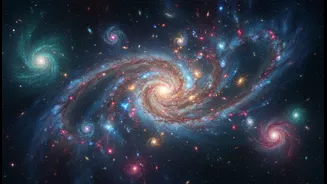
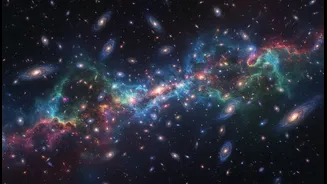
For decades, astronomers have believed that galaxy mergers are a fundamental driver of cosmic evolution. These are not simple fender-benders; they are slow, gravitational dances that can last hundreds of millions of years. As two galaxies draw closer,
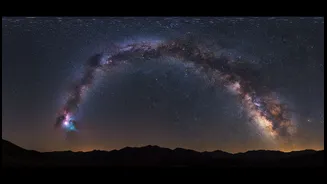
their immense gravity rips them apart, flinging out long streams of stars and gas called tidal tails. But amid this destruction, a powerful creative force is unleashed. The gravitational chaos compresses vast clouds of interstellar gas and dust, triggering furious bursts of star formation at rates far exceeding what a normal galaxy experiences. This process is thought to be a key chapter in the life story of most large galaxies, including our own Milky Way, which bears the scars and structures of ancient collisions.
The Mystery of Globular Clusters
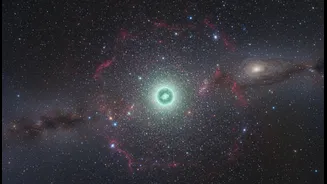
Among the most beautiful and enigmatic objects in the cosmos are globular clusters. These are ancient, spherical swarms containing hundreds of thousands, or even millions, of stars packed into a relatively small space. Our Milky Way has about 150 of them, orbiting its center like satellites. For a long time, the origin of these dense, old clusters has been a puzzle. How did so many stars form so close together, and so early in the universe's history? The leading theory has been that they are born in the extreme conditions of galaxy mergers, but direct evidence was scarce. These formation events are shrouded in so much gas and dust that traditional telescopes couldn't see the nurseries where these stellar families are born.
Webb's Infrared Eyes See the Unseen
This is where the James Webb Space Telescope (JWST) changes the game. Webb is designed to see the universe in infrared light, which can pass through the dense dust clouds that are opaque to visible light telescopes like Hubble. This gives it the unique ability to peer directly into the heart of chaotic, star-forming regions in merging galaxies. By combining this sensitivity with its incredible resolution, astronomers can now pinpoint the exact locations where new stars and star clusters are being forged. What was once a theoretical process hidden behind a cosmic veil is now being observed directly, star by star.
What the New Data Reveals
Recent observations from Webb have provided some of the most compelling evidence yet. In several instances, astronomers have observed multiple galaxies in the process of merging in the early universe. Within the violent maelstrom of these mergers, Webb has identified extremely compact, young, and massive star clusters — precisely what astronomers expected the ancestors of globular clusters, or "proto-globular clusters," to look like. One astonishing discovery revealed five of these nascent clusters in a galaxy seen when the universe was less than 500 million years old, providing a direct snapshot of this formation process near the cosmic dawn. The data shows that the most massive of these clusters emerge from their dusty cocoons very quickly, in just a few million years, and begin to powerfully influence the galaxy around them.
Building the Universe, One Cluster at a Time
These findings do more than just solve the riddle of globular clusters. They provide a clearer picture of how galaxies assemble themselves over cosmic time. By observing these mergers, astronomers are witnessing the mechanisms that build up the larger, more complex galaxies we see in the universe today. For example, observations of a system nicknamed "JWST's Quintet" show a merger of at least five galaxies triggering star formation at a rate ten times higher than normal for that early epoch. This intense activity not only builds new structures but also enriches the universe with heavier elements forged inside the new stars. Webb's data suggests these messy, complicated mergers were happening earlier and more efficiently than some models predicted, forcing a rethink of how quickly the early universe became a mature and structured place.