
More Than Meets the Eye
Our eyes are remarkable, but they are tuned to only a sliver of reality known as the visible spectrum. This is the rainbow of colours from violet to red. But light comes in many other forms, from low-energy radio waves to high-energy gamma rays. For astronomers,
these different wavelengths are like specialised tools. Each one reveals different objects and processes that are otherwise completely invisible.. For instance, cool objects like cosmic dust clouds and forming planets glow in infrared light.. Meanwhile, some of the most energetic events, like jets from supermassive black holes, are best seen in radio waves.. By building telescopes sensitive to these different energies, we can assemble a far more complete picture of the cosmos.
The New Eyes on the Cosmos
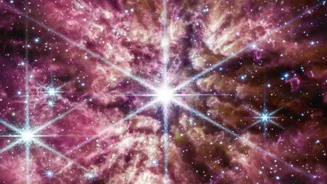
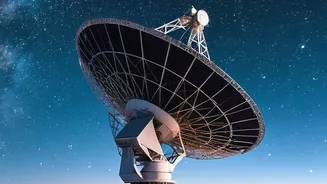
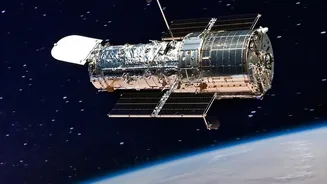
At the forefront of this new era of discovery are infrared observatories like the James Webb Space Telescope (JWST). Launched as a successor to Hubble, JWST is designed specifically to see the universe in infrared light.. This gives it two superpowers. First, infrared light can pass through the dense clouds of cosmic gas and dust that obscure many of the most interesting regions of space, like stellar nurseries where stars are born.. Second, because the universe is expanding, light from the most distant—and therefore oldest—galaxies gets stretched out to longer, redder wavelengths. JWST can detect this faint, ancient light, allowing us to peer back to the cosmic dawn.. Complementing this are powerful radio telescopes, which work by combining signals from many dishes to create a single, gigantic virtual telescope, giving them incredible resolution.
Revealing Cosmic Nurseries and Galactic Ghosts
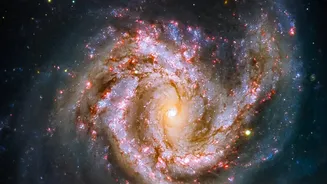
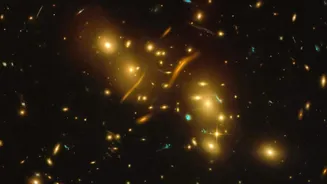
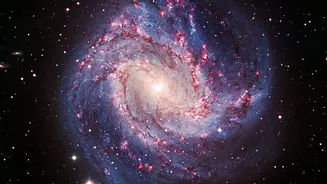
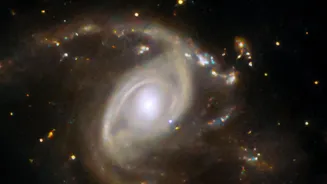
So, what are these hidden structures? One of the most significant revelations is our ability to see directly into star-forming regions. What looks like a dark, empty patch to a visible-light telescope is revealed by JWST to be a vibrant nursery teeming with newborn stars and the swirling disks of dust and gas that will eventually form planets.. Beyond our own galaxy, this technology is mapping the cosmic web—the faint, web-like structure of dark matter and gas that forms the invisible scaffolding of the universe.. Astronomers are also finding 'ghostly' galaxies that seem to be missing the dark matter that is thought to be essential for galaxy formation, challenging our core theories about the cosmos.. These discoveries are not just beautiful pictures; they are fundamental clues to how everything we see came to be.
Rewriting the Cosmic Story
Every new image and data point from these advanced telescopes is helping scientists refine the story of the universe. By studying the earliest galaxies, we can better understand how the first stars lit up the cosmos after the Big Bang.. By seeing through dust, we can create a more accurate census of how many stars are being born and how galaxies grow and evolve over billions of years. Observations of distant exoplanets are even revealing the chemical compositions of their atmospheres, a key step in the search for life beyond Earth.. This isn't just about adding details; it's about testing and sometimes overturning long-held theories about everything from black hole formation to the mysterious force of dark energy that is accelerating the expansion of the universe.