



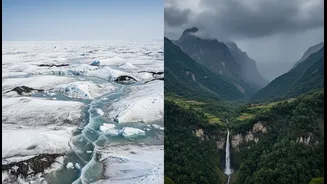


The Doomsday Glacier's Warning
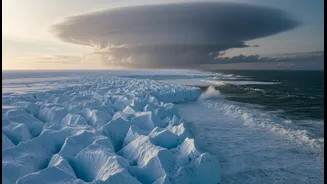
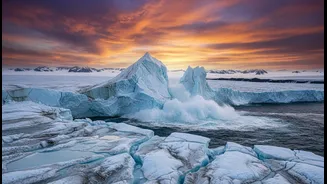
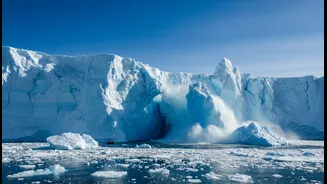
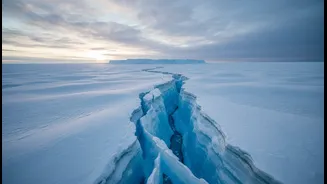
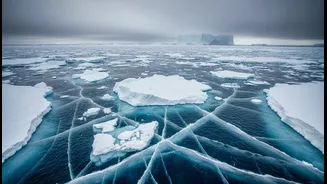
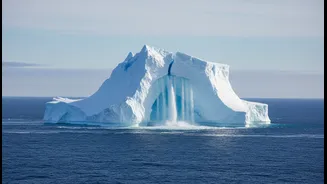
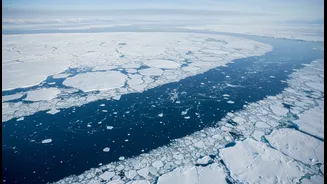
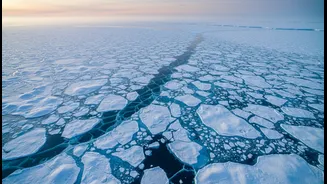
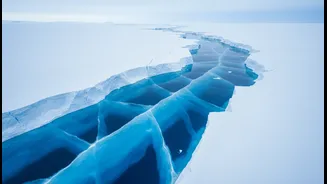
Thousands of kilometres away, a colossal ice stream called the Thwaites Glacier is showing signs of collapse. Nicknamed the “Doomsday Glacier,” its rapid melting is a major global concern. Recent reports from July 2026 confirm that its protective eastern
ice shelf is fracturing and could disintegrate any day, accelerating its slide into the ocean. If Thwaites were to collapse entirely, it holds enough ice to raise global sea levels by over two feet. But its real threat lies in its role as a cork for the rest of the West Antarctic Ice Sheet; its failure could eventually lead to a sea-level rise of over 10 feet. This isn't a distant problem for future generations. The effects are already in motion, and they have a direct line to India.
A Direct Line to the Indian Monsoon
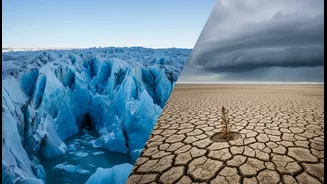
Antarctica acts as a giant weather engine for the planet. Its health is surprisingly connected to the Indian monsoon, the lifeblood of our agriculture and economy. Research shows a clear link between Antarctic warming, meltwater, and monsoon patterns. As vast amounts of freshwater pour into the Southern Ocean, it alters ocean density and weakens the Antarctic Circumpolar Current (ACC), the mightiest current on Earth. This slowdown, which could be as much as 20% by 2050, disrupts global heat distribution and atmospheric circulation. Studies have shown these changes can affect the major rain belts, leading to more erratic monsoons, with some parts of India getting too much rain and others, not enough—increasing the risk of both floods and droughts.
India's Coasts on the Frontline
The most immediate threat for India from a melting Antarctica is rising sea levels. With a long and densely populated coastline, India is acutely vulnerable. Cities like Mumbai, Chennai, Kolkata, and Surat are already facing increased risks of flooding. Projections show that a sea-level rise of just one meter could submerge huge swathes of land and displace millions of people. It’s not just about spectacular floods during storms; it's about the gradual, permanent inundation of low-lying areas, contamination of freshwater sources with saltwater, and the destruction of coastal livelihoods like fishing and agriculture. The melt from glaciers like Thwaites directly contributes to this existential threat facing our major coastal hubs.
Our Scientific Stake on the Ice
India is not just a passive observer of these changes; it is an active participant in Antarctic science and governance. As a signatory to the Antarctic Treaty, India has maintained a presence on the continent since 1981. Our research stations, 'Maitri' and 'Bharati', are crucial hubs for studying climate change, glaciology, and biodiversity. Indian scientists have discovered dozens of new microbes and contribute vital data to global climate models. Recognizing the need to stay at the forefront of polar research, India is planning to build a new, modern station, 'Maitri-2', by 2029. This investment underscores our nation's commitment to understanding the changes in Antarctica and their global impact.
A New Arena for Global Competition
As the ice recedes, Antarctica is also becoming a new frontier for geopolitical competition. The consensus-based system that has kept the continent peaceful and dedicated to science for over 60 years is under strain. Nations like China and Russia are expanding their presence, with some activities raising concerns about dual-use (scientific and military) capabilities. There is growing tension over potential future access to mineral resources and fisheries, which threatens to undermine the environmental protections in place. This strategic rivalry means that what happens in Antarctica is no longer just a scientific matter but an issue of international security and diplomacy, with consequences for the global order.