



Cosmic Cradles of Creation
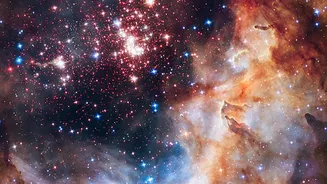
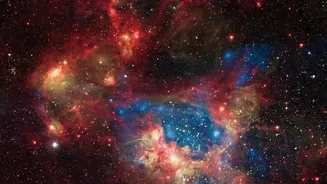
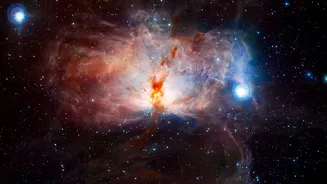
Every star begins its life within a vast, cold cloud of gas and dust known as a nebula. These aren't just empty patches of darkness; they are stellar nurseries, packed with the raw ingredients for new worlds. For a long time, the thick dust in these nebulae
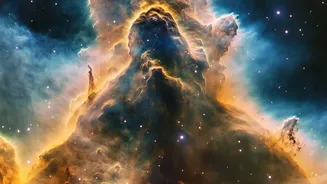
acted like a curtain, blocking our view of the processes happening within. Iconic structures like the Pillars of Creation, first made famous by the Hubble Space Telescope, are exactly these kinds of regions. While beautiful, their densest areas remained a mystery. Knots of gas and dust deep inside would begin to collapse under their own gravity, but the initial, crucial stages of a star’s birth were hidden from sight.
The Power of Infrared Vision
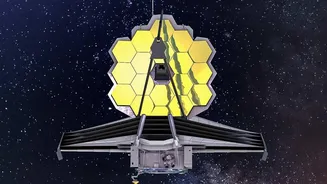
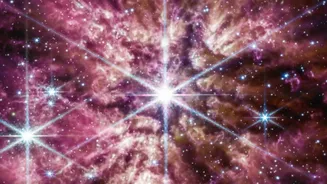
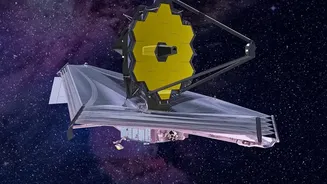
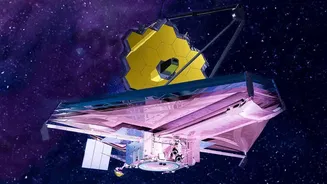
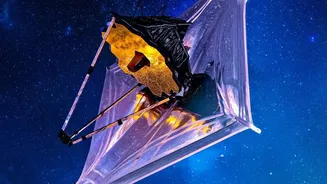
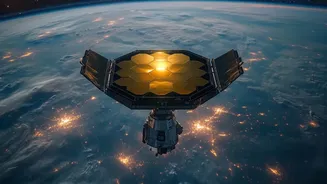
This is where the James Webb Space Telescope changes the game. Unlike telescopes that primarily see visible light, JWST is designed to capture infrared light. Think of interstellar dust like smoke in a room; it blocks what you can see across it. Infrared light, however, can pass through this cosmic smoke more easily. This allows JWST to pierce the dusty veil and see what’s happening inside these stellar nurseries. Regions that appeared as dark patches to Hubble are now revealed by Webb to be filled with glowing gas, intricate structures, and hundreds of previously hidden, newly forming stars.
From Collapse to Fiery Protostar
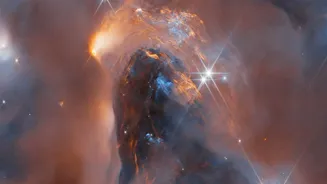
As a clump of gas and dust in a nebula grows dense enough, gravity takes over. The clump begins to collapse inward, spinning faster and heating up, forming a hot, dense core called a protostar. It's not yet a true star because it isn't powered by nuclear fusion. Instead, its heat comes from the friction and pressure of accumulating more material. Recent JWST images of regions like the Serpens Nebula show this phase in unprecedented detail. The telescope has captured powerful jets of gas, shown in stunning red hues, being blasted from these young protostars. In a groundbreaking discovery, Webb observed that many of these jets in the Serpens Nebula are aligned in the same direction, providing a historical record of how these stars were born together from the same spinning cloud.
The Moment of Ignition
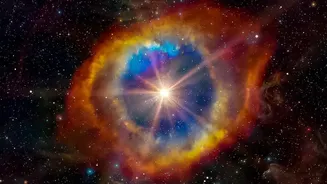
A protostar continues to grow by pulling in more gas and dust from its surroundings. For hundreds of thousands of years, its core becomes hotter and denser. Eventually, the temperature and pressure at its center become so extreme that it triggers the ultimate cosmic event: nuclear fusion. This is the moment a protostar graduates to become a main-sequence star, like our Sun. It stops collapsing and begins to shine with its own, self-sustaining energy. The energy released by fusion creates an outward pressure that balances gravity's inward pull, establishing a stable star that can burn for billions of years. Webb's ability to count and characterize these newly formed stars helps scientists refine their models of this entire lifecycle.
The Leftovers Build a Family
The birth of a star is not the end of the story; it's the beginning of a solar system. After the star ignites, the remaining gas and dust don't just disappear. Instead, this material flattens into a spinning disk around the newborn star, known as a protoplanetary disk. This is the construction site for planets, moons, and asteroids. JWST's instruments are sensitive enough to study the chemical composition of these disks, detecting the presence of water, carbon dioxide, and other molecules that are the building blocks of planets and potentially life. By observing these disks, astronomers are directly witnessing the varied paths of planet formation in progress and gathering clues about how our own solar system might have formed billions of years ago.