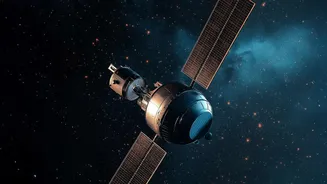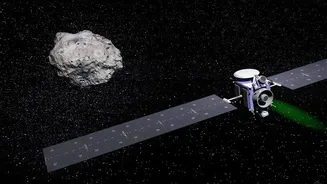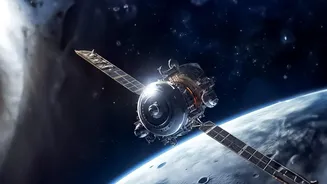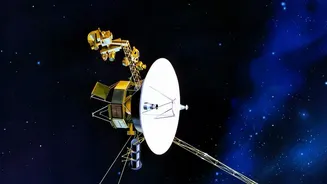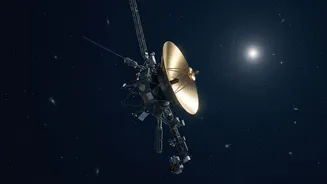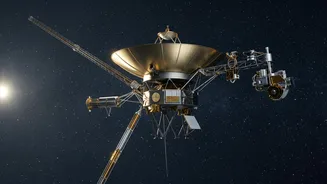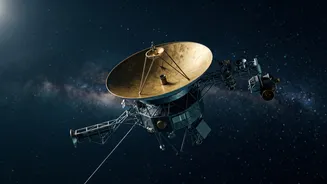


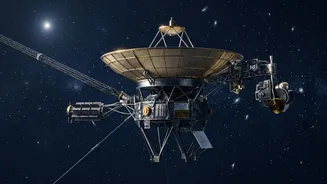
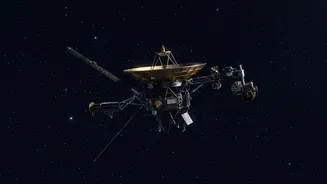
Launched nearly 50 years ago, NASA's Voyager 1 is humanity’s farthest emissary. Soon, it will achieve a staggering new milestone: traveling so far that its radio signal, moving at the speed of light, takes a full day to reach Earth.
A Journey Beyond Imagination
On November 18, 2026,
a quiet triumph for humanity will unfold in the silent depths of interstellar space. NASA’s Voyager 1 probe, a relic of 1970s engineering, will become the first human-made object to be one light-day away from its home planet. A light-day is the distance light travels in 24 hours — an almost incomprehensible 25.9 billion kilometers. At that distance, a round-trip communication with the spacecraft will take 48 hours. This milestone isn't just a number; it’s a testament to an incredible journey that began on September 5, 1977, and has pushed the boundaries of exploration ever since.
The Grand Tour and Its Discoveries
Voyager 1's original mission was to take advantage of a rare planetary alignment to visit Jupiter and Saturn. It performed its flyby of Jupiter in March 1979, revealing the first active volcanoes beyond Earth on the moon Io and discovering a faint ring around the gas giant. In November 1980, it reached Saturn, providing breathtakingly detailed images of its complex ring system and making a targeted flyby of the hazy moon Titan. That flyby used Titan's gravity to sling the probe upwards out of the plane of the solar system, beginning its long, lonely journey towards the stars. Its primary mission complete, its cameras were turned off in 1990 after taking one last iconic photo of Earth, the 'Pale Blue Dot', from 6.4 billion kilometers away.
Cheating Death in the Void
Keeping a nearly 50-year-old spacecraft alive is a monumental challenge. Its plutonium power source dwindles by about four watts each year, forcing engineers to make difficult decisions about which instruments to shut down. Today, only two of its original science instruments remain active, listening to the hum of interstellar space. The mission has faced recent scares, including a 48-hour communication blackout in October 2026 when an automated system switched to backup thrusters. Earlier in 2026, engineers executed a delicate power-saving maneuver nicknamed the 'Big Bang', swapping to lower-power devices to extend the life of the remaining instruments. These fixes, performed on a vintage computer from billions of kilometers away, are a stunning display of ingenuity.
Humanity's Farthest Footprint
In August 2012, Voyager 1 made history by crossing the heliopause — the boundary where the Sun’s solar wind gives way to the interstellar medium — officially entering interstellar space. It is now humanity’s most distant object, cruising at nearly 61,000 kilometers per hour. Yet, even at that speed, the vastness of space is humbling. It will take the probe another 300 years just to reach the inner edge of the Oort Cloud, a theoretical shell of icy objects surrounding our solar system. Its ultimate destination is a star named Gliese 445, which it will pass in about 40,000 years, its power long since depleted.
A Message in a Bottle
Attached to Voyager $^$is a message to the cosmos$ ^$the Golden Record. This gold$-plated copper disc contains sounds and images selected to portray the diversity of life and culture on Earth. It includes greetings in $^$55 languages, music from artists like Bach and Chuck Berry, and $^$115 images of our world. The record is a time capsule$, a symbolic gesture from a species that looked up at the stars and decided to reach for them. While its radio will fall silent sometime in the $^$2030s$, the probe and its golden cargo will continue their journey$, potentially for billions of years — a silent testament to human curiosity.