
Why Venus Remains a Planet of Mystery
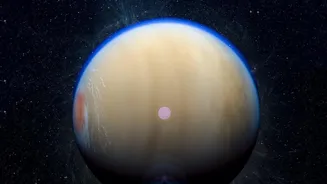
Venus is both strikingly similar to Earth and terrifyingly different. It is nearly the same size and mass, but its surface is hot enough to melt lead, and its atmosphere is over 90 times denser than ours. The planet is a victim of a runaway greenhouse
effect, where heat is trapped by a thick blanket of carbon dioxide, making it the hottest planet in our solar system. Understanding why our planetary neighbour took such a drastically different evolutionary path is a key scientific goal, offering crucial insights into planetary climates, including our own. For decades, the planet's permanent, opaque cloud cover, made of corrosive sulphuric acid, has hidden its secrets from view.
The Great Sulphuric Acid Obstacle
Peering beneath the Venusian clouds is a monumental challenge. These clouds are not just a visual barrier; they are a dynamic and chemically complex system that drives the planet's extreme weather. They permanently shroud the surface, making direct observation in visible light impossible. To understand what happens in the lower atmosphere, scientists need instruments that can either pierce this veil or analyse the subtle chemical fingerprints that hint at the processes occurring below. This is precisely where ISRO's Shukrayaan mission aims to make its mark, by deploying a suite of tools designed to investigate the structure, composition, and dynamics of the atmosphere in unprecedented detail.
ISRO's Toolkit for Peering Beneath the Veil
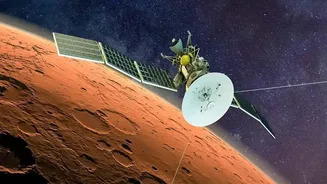
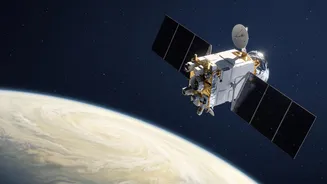
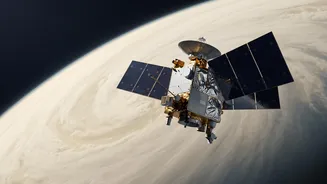
The Shukrayaan orbiter will carry a payload of approximately 19 scientific instruments, a mix of Indian and international hardware. A key instrument for atmospheric study is the Venus Infrared Atmospheric Gases Linker (VIRAL), a collaborative effort with Russia's Roscosmos and France's CNES. This sensor is specifically designed to analyse the composition of the atmosphere, looking for key gases. Shukrayaan will also carry a suite of spectrometers capable of observing in infrared, ultraviolet, and submillimeter wavelengths. These instruments work by detecting the unique signatures of different molecules, allowing scientists to map the distribution of gases like carbon dioxide and sulphuric acid, and even hunt for trace elements. A cloud monitoring camera and lightning sensor will also provide data on atmospheric dynamics and weather patterns.
Searching for Clues to a Runaway World
The data gathered by these sensors will help scientists understand the chemical cycles that dominate Venus. A primary goal is to study the reactions involving sulphur compounds, which are fundamental to the planet's atmospheric chemistry. Furthermore, the mission will contribute to the search for answers on a tantalising question raised in 2020: the potential presence of phosphine gas. On Earth, phosphine is associated with biological activity. While the initial detection is still debated, Shukrayaan's instruments, including VIRAL, are equipped to search for phosphine and provide more definitive data. In addition to atmospheric studies, the orbiter's Synthetic Aperture Radar (SAR) will pierce the clouds to map the surface, searching for signs of active volcanism, which could be a source of atmospheric gases.
A Landmark Mission for India
Scheduled for a launch in March 2028 aboard India's LVM-3 rocket, Shukrayaan marks ISRO's second interplanetary venture after the successful Mars Orbiter Mission (Mangalyaan). This mission cements India's position as a major player in planetary exploration. It joins a renewed global interest in Venus, with planned missions from NASA and the European Space Agency also set for the late 2020s and early 2030s. The mission's use of aerobraking—using the planet's own atmosphere to adjust its orbit—is also a significant technological demonstration. By collaborating with international partners like Sweden, Russia, and Germany, ISRO is not only expanding its own capabilities but also contributing to a global scientific effort to understand our enigmatic twin.