

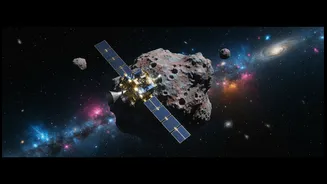


A New Target in Deep Space
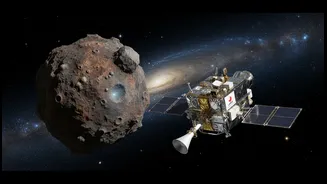
Japan’s Hayabusa2 spacecraft is a seasoned explorer. After its historic 2020 mission that successfully returned samples from the asteroid Ryugu, it wasn't retired. Instead, the Japan Aerospace Exploration Agency (JAXA) sent it on an extended mission.
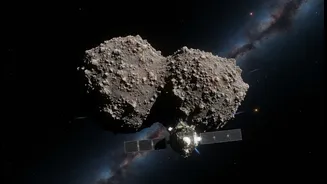
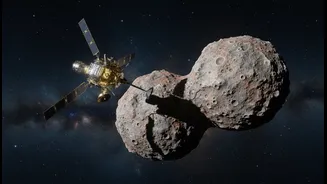
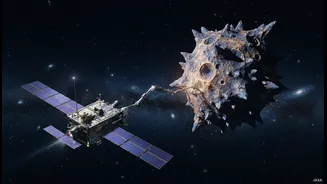
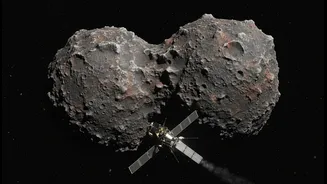
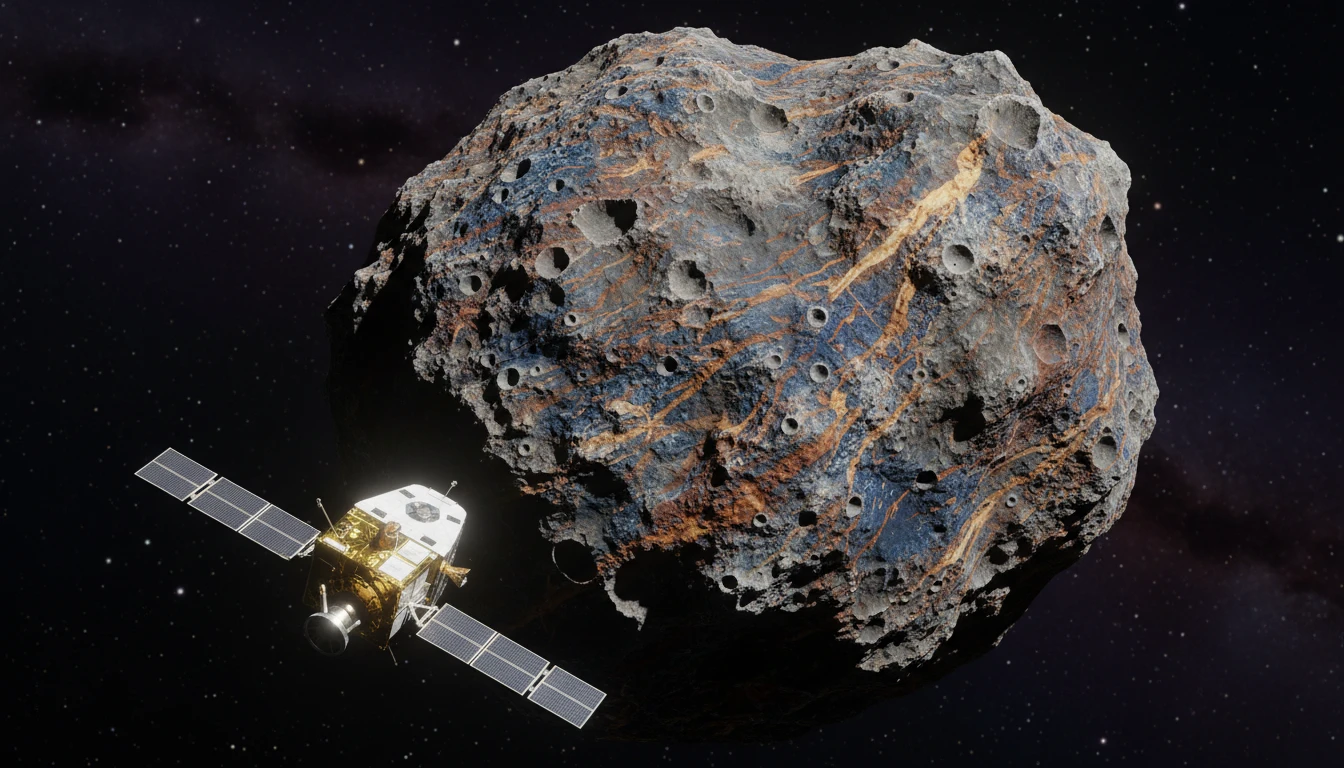
The first major milestone of this new journey was a flyby of a near-Earth asteroid known as (98943) Torifune, which took place successfully on July 5, 2026. The spacecraft sped past the roughly 450-metre, snowman-shaped asteroid at approximately 5 kilometres per second, capturing close-up images. Unlike its previous mission which involved landing and sample collection, this was a high-speed encounter designed to test the spacecraft's limits, particularly its ability to navigate in the most challenging of environments.
The Ultimate Navigation Test
Navigating in deep space is nothing like using Google Maps. There is no GPS. Instead, engineers rely on a complex dance of communication with Earth-based antennas, sending and receiving signals to determine a spacecraft's position and speed. This process, managed by networks like NASA’s Deep Space Network, is painstaking and requires precise timing. For the Torifune flyby, the challenge was immense. The asteroid is a small, dark object moving rapidly through space. Hayabusa2's onboard systems had to perform last-minute navigational adjustments to get as close as possible without colliding. This required the spacecraft to use its own Optical Navigation Cameras (ONCs) to see the asteroid and autonomously correct its course, as the time delay for commands from Earth would be too long to react in real-time.
Innovation Born from Necessity
To pull off this flyby, JAXA is refining several key technologies. The most critical is autonomous optical navigation, where the spacecraft essentially becomes its own pilot. By taking images of the target and the surrounding stars, the onboard computer can calculate its position relative to the asteroid and make its own course corrections. This reduces reliance on the constant back-and-forth with ground control. The mission also pushes the boundaries of sensor fusion—combining data from different instruments like cameras, thermal imagers, and laser altimeters to build a comprehensive picture of the environment. Honing these abilities is crucial not just for science, but as a key demonstration for planetary defence, as the same technology needed to precisely fly by an asteroid could one day be used to intercept one.
From Deep Space to Your Driveway
So, what does a spacecraft flying past a distant rock have to do with your daily commute? Everything. The challenges of autonomous navigation in space are remarkably similar to those faced by self-driving cars, delivery drones, and other next-generation vehicles on Earth. These systems cannot rely solely on GPS, which can be inaccurate in urban canyons or unavailable in remote areas. They need to 'see' and understand their surroundings using cameras, LiDAR, and radar, and make independent decisions—exactly what Hayabusa2 is doing. The algorithms developed to guide a probe through an asteroid field can be adapted to guide a car through city traffic or a drone through a complex delivery route. The need for robust, reliable navigation without constant external guidance is a shared problem, and the solutions being pioneered in space are directly informing development on the ground.
Why This Matters for India
For India, a nation rapidly digitising and building out its infrastructure, precision navigation is not a luxury but a necessity. The country's booming logistics and e-commerce sectors depend on efficient, accurate routing. Future smart city projects will rely on a network of interconnected devices and autonomous services that need to know their exact location. Furthermore, as India expands its own impressive space program, mastering deep-space navigation is a critical capacity for future missions to the Moon, Mars, and beyond. The technological leaps made by missions like Hayabusa2 provide a valuable roadmap, demonstrating solutions that could be adapted for both terrestrial and celestial navigation challenges. Better navigation translates into more efficient supply chains, safer autonomous transport, and greater capabilities in space exploration—all areas of strategic importance for India's growth.