



The universe is unimaginably vast, but the James Webb Space Telescope (JWST) keeps making it feel a little smaller. In a stunning new discovery, astronomers have spotted two colossal quasars nestled incredibly close together in the cosmic dawn.
First, What Is a Quasar?
Before
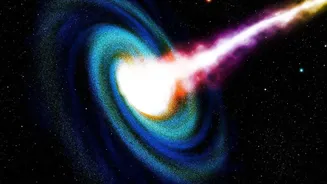
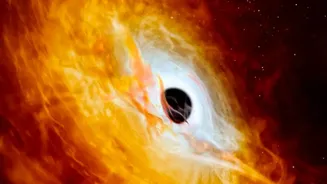
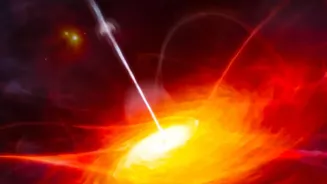
diving into the discovery, let's unpack what a quasar is. Imagine a supermassive black hole, with the mass of millions or even billions of suns, sitting at the centre of a young galaxy. Now, imagine that black hole is on a feeding frenzy, pulling in enormous amounts of gas and dust. As this material spirals into the black hole, it forms a superheated disk that shines with unimaginable intensity. This brilliantly luminous object is a quasar, short for 'quasi-stellar object'. They are so bright they can outshine all the stars in their entire galaxy combined, making them visible to us even from billions of light-years away. Because their light takes so long to reach us, observing distant quasars is like looking back in time to the early universe.
A Cosmic Pair, Unprecedentedly Close
The latest finding from JWST, with help from the Gemini North telescope in Hawai'i, has identified a pair of these cosmic beacons, designated J1602+4228AB. What makes this discovery so remarkable is their proximity: they are separated by only 18,100 light-years. While that sounds like a huge distance, on a cosmic scale, it is incredibly close — roughly one-fifth the diameter of our entire Milky Way galaxy. The discovery was made by spotting a faint companion next to a known quasar during the JWST's Aether survey, a project designed to create a census of objects in the early universe. This finding represents the most distant compact quasar pair ever identified, seen as they were just 900 million years after the Big Bang.
Why Their Proximity Matters
Finding two massive quasars this close together is a smoking gun for one of the most important processes in the cosmos: galaxy mergers. Astronomers believe that large galaxies are built up over billions of years as smaller galaxies collide and merge. This chaotic process funnels huge amounts of gas toward the central black holes of each galaxy, igniting them as quasars. Seeing two quasars so near to one another strongly suggests we are witnessing two galaxies in the middle of a cosmic collision. This provides direct evidence of this fundamental process of galaxy growth happening very early in the universe's history, something that was long theorised but rarely observed with such clarity.
A Puzzle for Modern Cosmology
This discovery also presents a significant puzzle. The two black holes powering these quasars are enormous, estimated at 1.5 billion and 400 million times the mass of our sun. According to current models of cosmology, it's difficult to explain how these black holes could have grown so massive, so quickly after the Big Bang. The existence of a single such massive quasar so early is already a challenge to theories, but finding two of them together suggests that the processes of galaxy and black hole growth in the primordial universe were perhaps far more rapid and intense than previously thought. It implies they must have formed in an unusually dense part of the early cosmos where the ingredients for growth were plentiful.
The Power of Webb's Infrared Eye
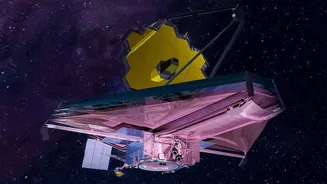
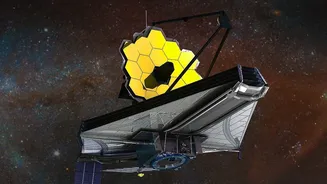
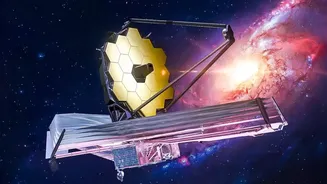
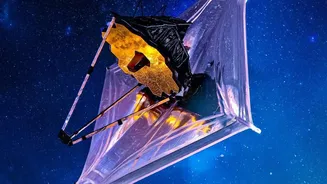
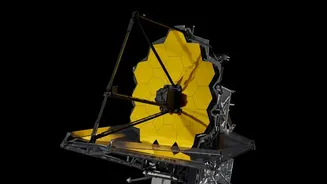
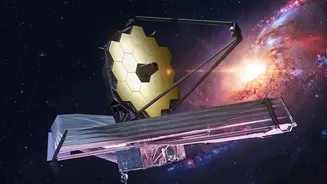
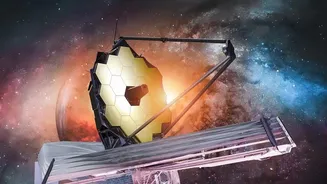
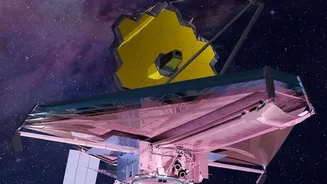
This breakthrough would not have been possible without the unique capabilities of the James Webb Space Telescope. Its large, gold-coated mirror is designed to capture faint infrared light that has travelled for billions of years across the expanding universe. This allows it to see objects that are too old, distant, or faint even for the Hubble Space Telescope. In this case, JWST's high-resolution infrared imaging was crucial to first detect the faint companion, separating the two dazzling points of light that would be almost impossible to resolve from the ground under normal conditions. It’s a testament to the telescope's power to peel back the layers of cosmic history and reveal the universe in unprecedented detail.