


The Ultimate Logistical Challenge
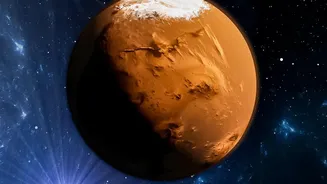
Establishing a human presence on Mars is less a question of rocketry and more a challenge of logistics. A trip to Mars is like a journey from Logan, Utah to Antarctica, making resupply missions for essentials like food almost impossible. Any long-term
settlement will depend on what is known as in-situ resource utilization (ISRU), which means using what's already there to survive. For agriculture, this presents a monumental task. Unlike the dramatic ease portrayed in films, Martian farming is fraught with difficulties that must be solved decades before the first crewed mission lifts off. The cost and complexity of transporting food make local cultivation a necessity, not a choice, for the survival of any Martian colony. This has turned Martian agriculture into a critical area of research and development, creating a new frontier for innovation.
A New Generation of Innovators
While major space agencies lead the charge, a significant portion of the foundational research is being conducted in university labs and student competitions. Programs like NASA's Plant the Mars Challenge and the Conrad Challenge are engaging undergraduate and even high school students to tackle real-world astrobiology problems. For example, a team of Texas students recently developed a concept called 'Gaia's Outpost' to process Martian surface material into a viable growing medium. These initiatives provide students with access to Martian soil simulants—Earth-based materials that mimic the chemical and physical properties of the Red Planet's surface—allowing them to experiment with potential solutions. This hands-on research is not just an academic exercise; it's generating valuable data that could one day feed astronauts millions of kilometres from home.
It All Starts with the Soil
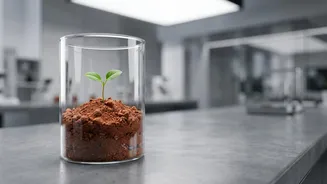
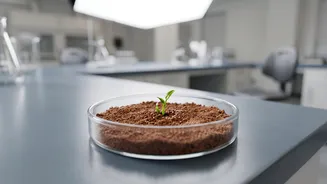
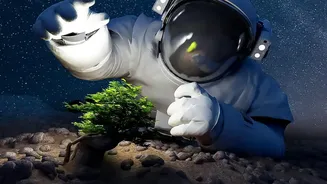
The primary obstacle is the Martian 'soil' itself, correctly termed regolith. It’s essentially lifeless crushed volcanic rock, completely lacking the organic matter and microbial life that make Earth's soil fertile. Worse, it contains toxic compounds called perchlorates, which are harmful to both plants and humans. Student teams are experimenting with methods to overcome this. One undergraduate project discovered that simply washing the regolith simulant was necessary to remove toxins before their soybean plants could grow. Another high school-led project found that alfalfa, a hardy plant, could grow in the poor-quality simulant and, when composted, could serve as a fertilizer to help other food crops like radishes and lettuce take root. Researchers are also exploring the use of beneficial fungi and bacteria to break down toxins and cycle nutrients, essentially creating living soil from scratch.
Beyond the Dirt: Light, Water, and Air
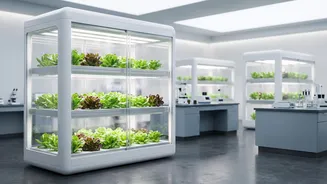
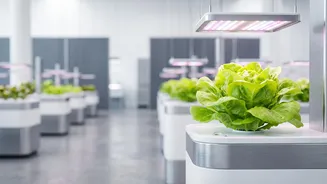
Even with perfect soil, Martian farmers would face other challenges. Mars receives significantly less sunlight than Earth, and its thin atmosphere offers little protection from cosmic radiation. This means any Martian greenhouse would likely need to be underground or heavily shielded, requiring powerful and efficient artificial lighting, such as LEDs, to sustain crops. Water on Mars is believed to be frozen or extremely briny, meaning it would need to be extracted and desalinated before use. Furthermore, plants need a breathable atmosphere. Experiments have shown that plants cannot survive in Mars's carbon-dioxide-rich environment without a controlled, oxygenated greenhouse. To address this, students and researchers are designing closed-loop systems where plants, humans, and waste recycling all support each other—plants would provide food and oxygen, while human waste would be processed to provide water and nutrients for the plants.
From Campus Labs to the Red Planet
The work being done by students is yielding promising, if early, results. Experiments have successfully grown a variety of crops in simulated Martian soil, including tomatoes, peas, radishes, and rye. While biomass production can be lower than in Earth soil, the fact that germination and growth are possible is a major step forward. Some projects are even thinking about the business case; the 'Gaia's Outpost' team estimated a potential multi-billion dollar market for their agricultural modules, targeting government agencies and private aerospace companies. These student experiments are not just about proving a concept; they are about de-risking future missions. Every problem solved in a lab on Earth is one less life-threatening variable for astronauts on Mars. This research provides more than just food; it offers psychological benefits, oxygen production, and a sustainable foundation for humanity's future off-world.