





The Rise of the 'Centaur'
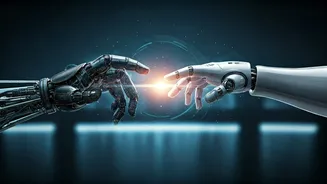
The idea that humans and AI are collaborators, not competitors, is best captured by the 'centaur' model. The term was coined by chess grandmaster Garry Kasparov. After his historic loss to IBM's Deep Blue computer in 1997, Kasparov pioneered a new form
of the game called 'freestyle chess'. In these tournaments, human-and-computer teams competed against each other. The surprising result? The winning teams were not always grandmasters paired with supercomputers. Often, they were average players who were exceptional at working with AI partners. A human-machine team could consistently beat any human or any computer playing alone. This model provides a powerful metaphor for the modern workplace. It’s not about having the best AI or the top human expert; it's about the quality of the process that brings them together. The AI provides incredible computational power, processing vast amounts of data to find patterns and possibilities, while the human provides strategy, intuition, context, and purpose.
Improving Accuracy in High-Stakes Fields
Nowhere is the benefit of this collaborative intelligence more critical than in healthcare. AI models are exceptionally good at analysing medical images and data, often spotting anomalies that a human eye might miss. For example, multiple studies have shown that while an AI can be highly accurate in diagnosing conditions like skin cancer from images, its performance is significantly enhanced when combined with a physician's oversight. A human-AI team achieves higher accuracy than either the doctor or the AI working solo. The AI acts as a tireless, hyper-vigilant assistant, flagging potential issues, while the clinician brings contextual understanding of the patient's history and real-world symptoms to make the final call. This synergy reduces diagnostic errors, speeds up processes, and ultimately improves patient safety and outcomes, demonstrating a model where technology augments, rather than replaces, invaluable human expertise.
A Partner for Human Creativity
The collaborative principle extends beyond analytical tasks into the realm of creativity. The narrative that AI will replace artists is giving way to a new reality where AI acts as a creative companion. For writers, designers, musicians, and filmmakers, generative AI tools have become powerful partners for brainstorming, prototyping, and overcoming creative blocks. A designer can use an AI to generate dozens of visual concepts in minutes, freeing them up to focus on higher-level strategy and refinement. A screenwriter can use a language model to explore plot variations or dialogue options. This process doesn't diminish human creativity; it enhances it by automating tedious parts of the process and opening up new avenues for exploration that would have been too time-consuming before. This partnership democratises creativity, allowing more people to bring their ideas to life, while pushing professional creators to new heights.
The Opportunity for the Indian Workforce
For India, with its vast technology workforce and burgeoning digital economy, the centaur model presents a massive opportunity. The conversation is rapidly shifting from job loss to job redefinition. Routine tasks in sectors like IT, BPO, and data entry are increasingly being automated, but this is creating demand for new, higher-value roles focused on human-AI collaboration. The future lies in professionals who can manage, validate, and creatively apply AI tools. NASSCOM reports highlight a growing demand for 'AI-ready' specialists who can bridge the gap between technology and business strategy. This transition requires a nationwide focus on upskilling and reskilling. Initiatives like the IndiaAI Mission and Skill India are already working to equip the workforce with skills in data analytics, machine learning, and AI fundamentals. For India's professionals, mastering the ability to work alongside AI is no longer optional; it is the key to career advancement and driving the next wave of economic growth.