


What is Space Weather?
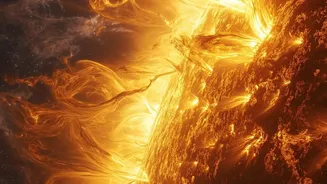
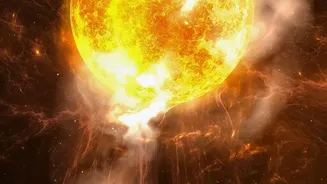
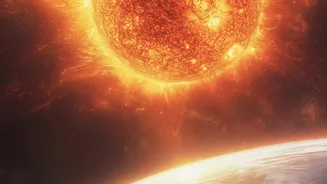
Space weather refers to the changing conditions in space, driven by the sun's activity. The main sources are solar flares—intense bursts of radiation—and Coronal Mass Ejections (CMEs), which are massive eruptions of plasma and magnetic fields from the sun's outer
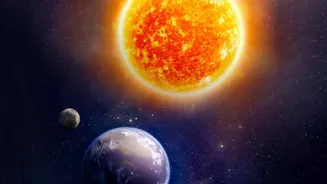
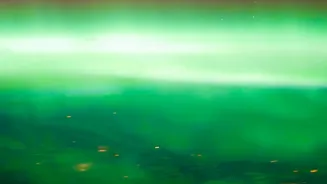
atmosphere. When a CME is aimed at Earth, it can trigger a geomagnetic storm, a major disturbance of our planet's magnetic field. While these events can produce beautiful auroras far from the poles, they also pose a significant risk to the technological backbone of modern society.
The Threat to Our Power Grids
The most significant terrestrial threat from a solar storm is to our electrical power grids. A powerful geomagnetic storm can create what are known as geomagnetically induced currents (GICs). These are low-frequency DC currents that flow through the high-voltage transmission lines, which are designed for AC power. GICs can flow into the massive transformers that are the heart of any power grid, causing them to overheat, saturate, and potentially suffer permanent damage. A severe event could lead to a cascading failure, resulting in widespread and long-lasting blackouts. The 1989 Quebec blackout, which left millions in the dark for hours, was caused by a solar storm far less powerful than the most extreme events recorded in history, like the 1859 Carrington Event.
Danger in Orbit for Satellites
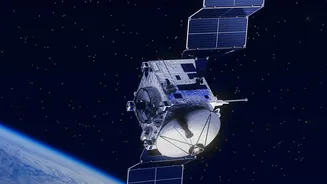
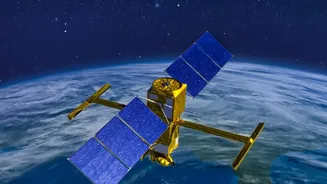
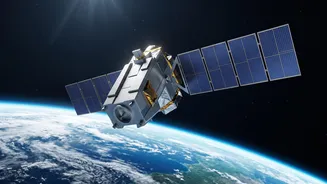
Satellites orbiting outside Earth's protective atmosphere are on the front line of space weather. The charged particles from a solar storm can damage sensitive electronics, causing malfunctions or complete failure. Increased solar activity also heats up Earth's upper atmosphere, causing it to expand. This increases the atmospheric drag on satellites in low-Earth orbit, which can alter their trajectory and even cause them to de-orbit prematurely, as seen with a batch of Starlink satellites in 2022. Given our reliance on satellites for everything from GPS navigation and communication to financial transactions and weather forecasting, protecting these orbital assets is critical.
A Global Network of Solar Sentinels
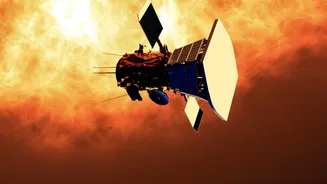
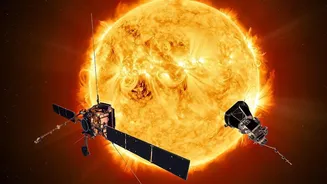
To provide advance warning, a network of space- and ground-based observatories constantly monitors the sun. Agencies like the USA's Space Weather Prediction Center (SWPC), part of NOAA, and the European Space Agency (ESA) are key players. Satellites like the Solar and Heliospheric Observatory (SOHO) and the Deep Space Climate Observatory (DSCOVR) are positioned at a special point in space called Lagrange Point 1 (L1), about 1.5 million km from Earth. This location gives them an uninterrupted view of the sun and allows them to detect solar wind and CMEs before they reach our planet, providing a lead time that can range from minutes to days. Based on this data, they issue watches, warnings, and alerts that allow operators to take protective action.
India’s Eye on the Sun: Aditya-L1
India has become a key player in this global effort with the Aditya-L1 mission. Launched by ISRO in 2023, Aditya-L1 is also positioned at the L1 point, providing India with its own independent and continuous stream of solar data. The mission's instruments study the sun's atmosphere, track CMEs, and measure the solar wind, contributing vital information to the global understanding of space weather. This data is crucial for developing India's own space weather forecasting capabilities, helping to protect the nation's rapidly expanding technological infrastructure, from power grids to its vast satellite networks. ISRO also collaborates with ground-based observatories across the country to create a comprehensive picture of space weather's impact on the region.
How Alerts Help Protect Infrastructure
When a warning is issued, power grid operators can take preemptive measures to mitigate the impact of GICs. They might reduce the load on certain lines, postpone maintenance, or even temporarily disconnect vulnerable transformers to prevent damage. For satellites, operators can put sensitive electronics into a safe mode, temporarily shut down non-essential systems, or adjust orbits to minimize exposure to radiation and atmospheric drag. These early warnings are essential for turning a potentially catastrophic event into a manageable one, safeguarding the services that power our modern world.