





An Icon's Final Orbit
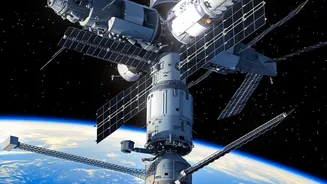
The International Space Station is an unparalleled feat of engineering and global cooperation. Since its first modules were launched in 1998, it has hosted nearly 300 astronauts and served as a crucial laboratory for scientific research. But after three
decades in the harsh environment of space, the station is showing its age. Structural fatigue, recurring air leaks, and the sheer cost of maintenance—nearly $3 billion per year for NASA alone—have made its retirement a necessity. The plan is to guide the 430-tonne structure to a controlled reentry over a remote part of the South Pacific Ocean around 2030. To accomplish this, NASA has contracted SpaceX to build a special Deorbit Vehicle, ensuring the station's final descent is a safe one. This deliberate end marks a pivotal moment, closing the chapter on a government-led model of life in orbit.
NASA's Handover Strategy
To avoid a gap in American presence in low-Earth orbit (LEO), NASA is not building a direct replacement for the ISS. Instead, it's turning to the private sector. Through a program called Commercial LEO Destinations (CLD), the agency is funding several companies to develop their own space stations. The goal is for NASA to become just one of many customers, buying services like research time and astronaut accommodation from these commercial operators. This shift frees up NASA resources to focus on deep space exploration, like the Artemis missions to the Moon, while fostering a new, competitive marketplace in LEO. However, the strategy has seen shifts. In early 2026, NASA briefly considered developing a government-owned core module for companies to plug into, before reversing course to stick with the original plan of funding fully private, free-flying stations.
The New Players in Orbit
Several key players have emerged in the race to build the first commercial successors to the ISS. Axiom Space, which already runs private astronaut missions to the station, plans to attach its first module to the ISS around 2027. Eventually, these modules will detach to form the independent Axiom Station. Another major contender is Vast, which aims to launch its single-module Haven-1 station as early as 2027, potentially making it the first free-flying commercial station. Other ventures include Orbital Reef, a partnership between Blue Origin and Sierra Space envisioned as a "mixed-use business park" in space, and Starlab, a joint project from Voyager Space and Airbus focused on creating a large habitat and laboratory. Each company is taking a different approach, from Axiom's bridge strategy to the large, standalone concepts of Orbital Reef and Starlab.
A New Economy in the Stars
These new stations won't just be for government astronauts. Their business models are built on serving a diverse range of customers. This includes everything from in-space manufacturing of unique materials like fiber optics and pharmaceuticals to cutting-edge microgravity research for private companies and academic institutions. High-end space tourism is another major market, with companies like Axiom already offering seats to the ISS for around $55 million. The vision is to create a vibrant ecosystem where businesses can establish their own address in orbit, opening up new commercial opportunities that were once the exclusive domain of national space agencies.
Racing Against the Clock
The primary challenge is time. The ISS has a firm retirement date, and any delays in getting these new commercial stations operational could create a gap where the U.S. has no human presence in low-Earth orbit. The technical and financial hurdles are immense. Building a space station is a monumental undertaking, and while NASA is providing seed funding, these companies must also raise significant private capital. Axiom raised $350 million in early 2026 to accelerate its plans. Meanwhile, some partnerships, like the one for Orbital Reef, have faced reports of internal friction, highlighting the complexities of these ambitious projects. Successfully launching and operating these platforms by 2030 will require a flawless execution of complex manufacturing, launch, and on-orbit assembly schedules.